
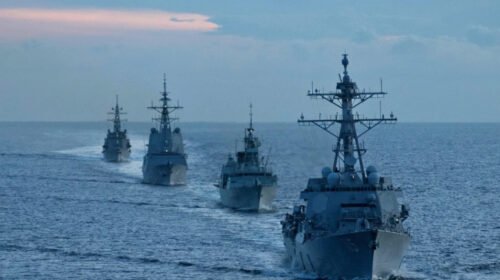
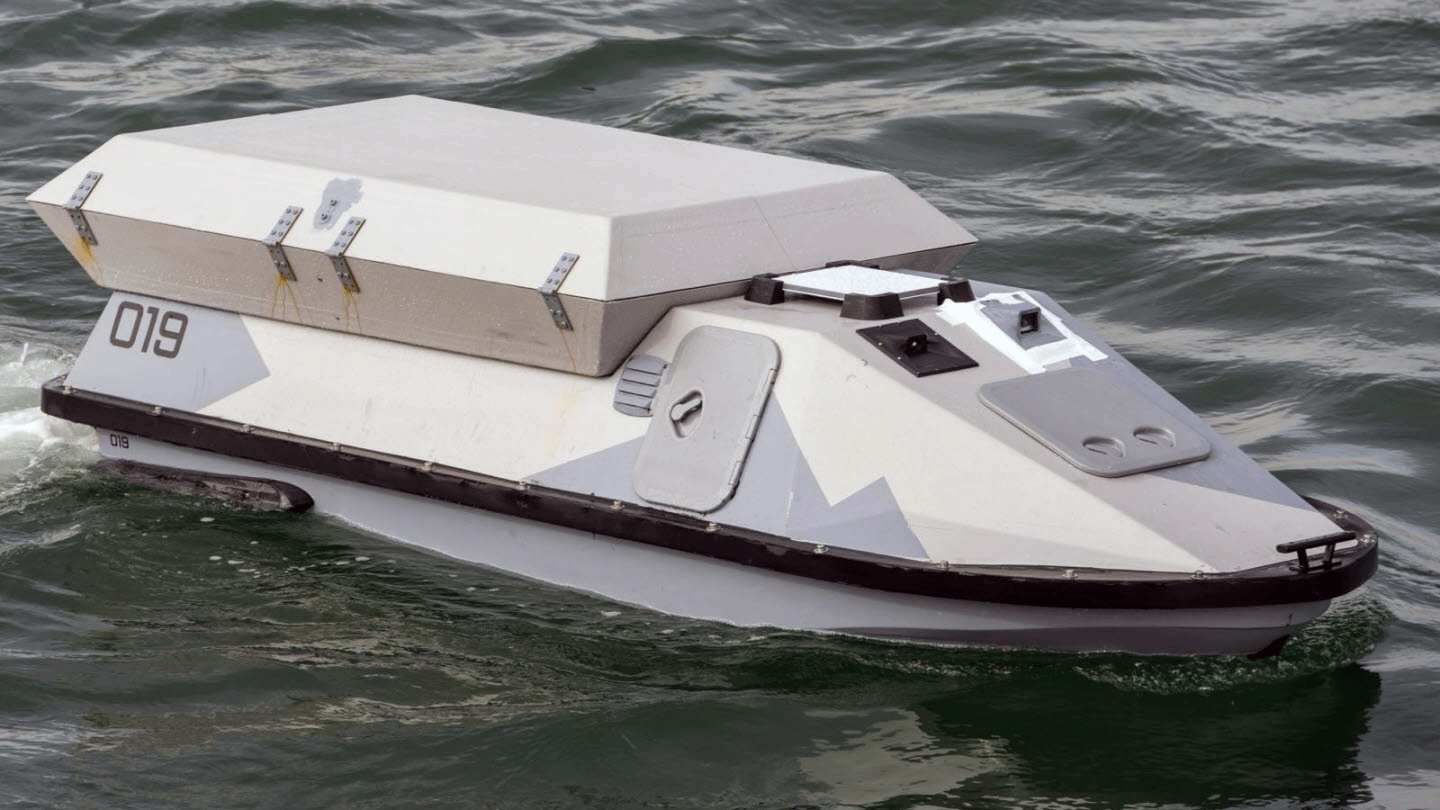
The navy is set to grow and become more effective. Sea-going drones are part of the development – the future was glimpsed in a recently concluded NATO exercise off the coast of Portugal.
Unmanned vehicles have quickly transformed naval warfare. They can detect enemy ships, submarines and movements long before they reach their own territory – and can do so more cheaply and sustainably than manned ships and aircraft.
The unmanned systems can also be used for precision attacks or to disrupt and overload enemy defense systems, all without risking their own personnel, who are located elsewhere.
New Swedish drones tested
At the end of September, around 70 Swedish officers, engineers and technicians showed where Sweden stands in development. During the NATO exercise Repmus/Dynamic Messenger 25, which was held in areas outside Sètubal, south of Lisbon, the Swedes were formed into a Team Sweden.
Several new Swedish-built sea drones were part of the Swedish force, which also demonstrated the crucial digital system that will be used to control and lead the unmanned vehicles.
– We have focused on how things work together. What the different platforms can do and how, and not least how this activity should be controlled and managed, says Captain Magnus Lind, development officer.
Taking on dangerous missions
Team Sweden’s force included Saab’s AUV 62AT, an established platform. The craft resembles a large torpedo packed with state-of-the-art technology.
It is used as a submarine target and is an autonomous vehicle for practicing submarine hunting and has been used by the Armed Forces for several years. Another version of the vehicle (AUV 62 MR) can also be used to find and identify mines using the sensors on board the vehicle, says Commander Therese Tärnholm, the Navy’s Head of Research.
These are a good example of unmanned platforms that can take over personnel-intensive and risky missions in the navy.
On the water and in the air
The autonomous surface vehicle 3T from Sweden’s Nautrik was part of the force, along with the unmanned aerial system V-200 from Skeldar. The latter can be described as a small unmanned helicopter with a range of functions. The smaller hydrofoil vehicle Ghostfoiler, developed by the Royal Institute of Technology, KTH, was also part of the force.
This year’s exercise was the largest to date with over 2,000 participants, several universities, 120 companies and 32 national marine organizations.
Swedish system of management
For autonomous systems to be used successfully, effective management is needed. The exercise in Portugal has provided answers to how this can be done.
The Swedish drones were controlled from a virtual ship named CTU Stockholm. The ship’s command was manned by personnel from the Navy and the Swedish Defence Materiel Administration, FMV.
It has worked very well. We used a control system developed by the Swedish company Miraya. It is used to control unmanned systems together with the vehicles of other nations and organizations, says Therese Tärnholm.
A big advantage of forming a Swedish team is the opportunity to save time; changes can be made quickly on site when those involved in the projects are in place.