
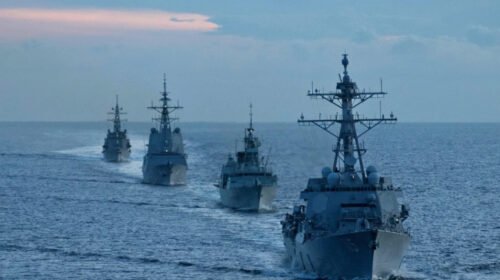
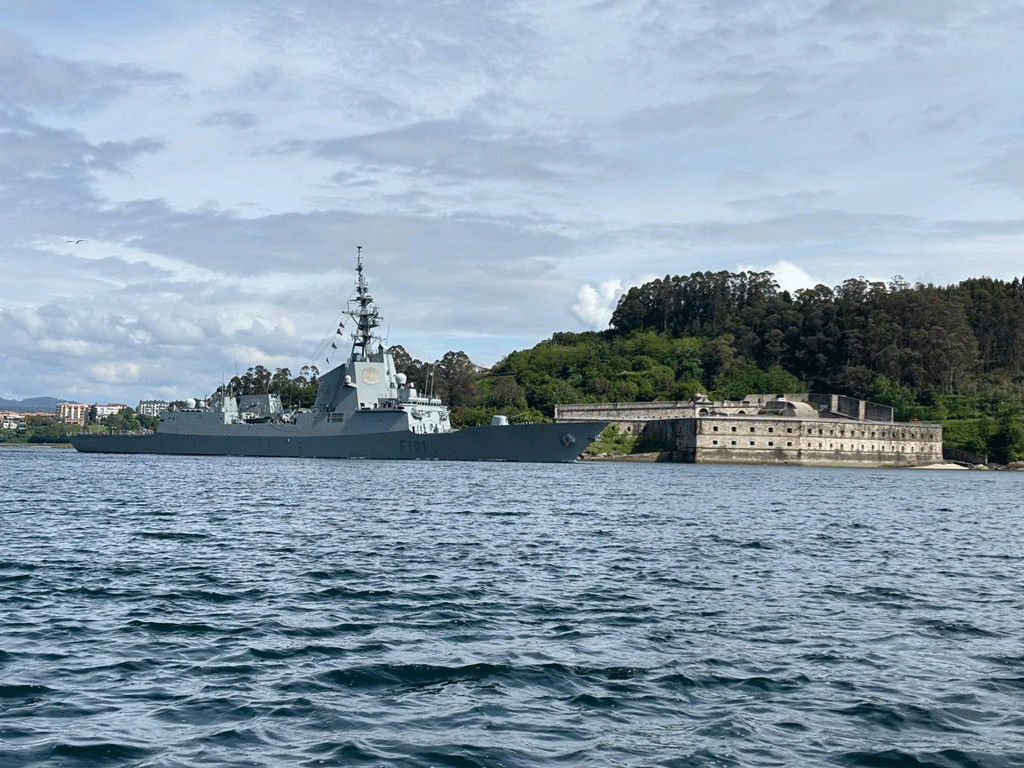
The frigate ‘Álvaro de Bazán’ (F-101) set sail today from her home port (Ferrol Naval Station) to begin a deployment in the Atlantic and Pacific Oceans, where she will operate alongside some of the world’s leading navies. Throughout the deployment, the frigate will participate in several advanced exercises organized by the U.S. Navy and other allied and partner nations, integrating into multinational naval groups and conducting training in high-intensity scenarios. These include air and missile defense exercises, maritime surveillance, and joint maneuvers.
Furthermore, during one of the most significant phases of the deployment, the frigate will serve as flagship for the international missile defense exercise ‘Pacific Dragon’ (PAC DRAGON), embarking the Commander of the U.S. Navy’s Destroyer Squadron 31 and his Staff. “Taking on this responsibility entails professional prestige and credibility; technological reliability with a proven and capable combat system; demonstrated interoperability; strategic influence and high-value expertise with advanced training in complex decision-making situations, coordination and management of high-intensity scenarios,” highlights the Commander of the F-101, Cdr. Álvaro Zaragoza.
This unprecedented deployment will also include port calls at different cities in the Americas and the Pacific, including transiting the Panama Canal, thus consolidating the Armada’s international presence and projection in areas of growing strategic importance. The Commander of the F-101 added that “Spain’s security and interests are not defended solely within the immediate vicinity of our sovereign waters. A country as deeply dependent on maritime trade and global logistics as Spain, needs to be able to operate in distant theaters such as the Indo-Pacific.”
RIMPAC and PACIFIC DRAGON Exercises.
RIMPAC, led by the U.S. Navy’s Pacific Fleet, is the world’s largest international maritime exercise and will celebrate its 30th edition this year, coinciding with the 250th anniversary of U.S. independence. The exercise intends to strengthen multinational cooperation, mutual trust, and interoperability among allied and friendly naval forces, promoting integrated forces prepared to operate jointly in an increasingly complex maritime environment. It will bring together elements from approximately 30 countries and will feature a wide range of highly complex naval, air, and amphibious activities. Furthermore, the exercise will have a multinational command structure.
For its part, ‘Pacific Dragon’ (PAC DRAGON), organized by the U.S. Third Fleet, is a biennial exercise specializing in ballistic missile defense, designed to improve the capability of participating forces to jointly operate in the detection, tracking, and interception of ballistic threats. The exercise combines simulated events and live missile firings in an integrated air and missile defense environment, allowing for the adjustment of tactical procedures and strengthening interoperability among allies and strategic partners.
The participation of the F-101 in these exercises for the first time, is possible thanks to the effort and preparation of the 191 people who make up the frigate’s crew, including 29 women, who have undergone an intensive period of readiness and operational training in recent months, as well as the significant logistic and support work carried out in those days.
Commander Zaragoza emphasizes that “the crew has trained to confidently handle any mission assigned to them. Specifically, our readiness began in December, following an intensive period of scheduled immobilization and general maintenance of the platform. Since then, the ship has participated in several individual and collective activities, notably her integration into the French Naval Air Combat Group of the aircraft carrier ‘Charles de Gaulle’ (R-91) in the Mediterranean and the Bay of Biscay.” Cdr. Zaragoza added that “the confidence in a job well done is based on the demanding operational qualification that the whole crew underwent last March in Rota (SW Spain), where the frigate demonstrated her high capabilities in all areas, with particular emphasis on anti-air warfare.”