
Between August 15 and September 15, the Oceanographic Vessel “Cabo de Hornos” carried out its thirtieth cruise of the Scientific-Marine Research Program in Remote Areas, called CIMAR 30 Norte , between Arica and Chañaral Island, the purpose of which was to contribute to the study of oceanographic, atmospheric, geological processes and their interactions in the northern part of the country.
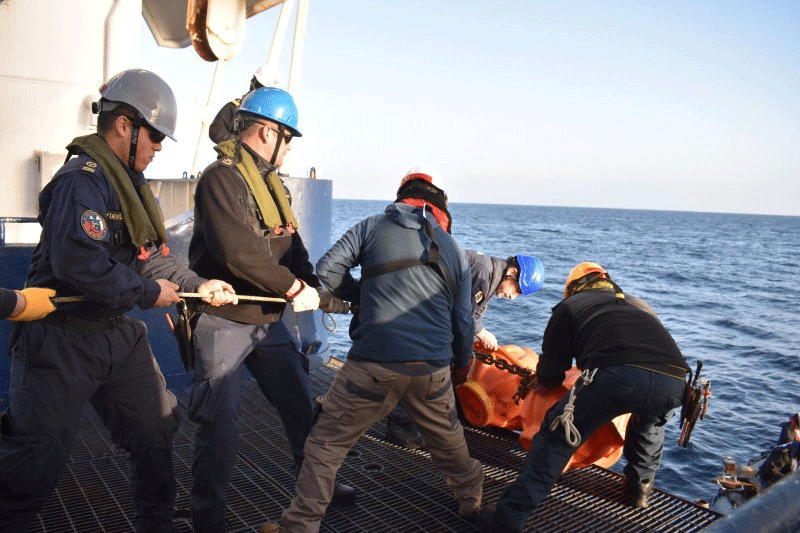
During the mission’s development, the unit supported the scientific community at more than thirty stations, where the various scientists on board were able to take measurements, take samples, and conduct various studies that contribute to the development and understanding of our waters and their depths.
This commission is part of the 2021-2025 Five-Year Plan and the National Oceanographic Plan to meet the objectives of the National Oceanographic Committee (CONA).
In this regard, the Head of the Hydrography and Oceanography Department of the AGS-61 “Cabo de Hornos,” 2nd Lieutenant Eduardo Varas, stated that, “During this voyage, the Unit supported the scientific community at more than thirty stations, where the various scientists on board were able to take measurements and samples, as well as conduct various studies that contribute to the development and understanding of our waters and their depths.”
On the other hand, Oscar Pizarro, Scientific Director of the Oceanographic Instrumentation Center at the University of Concepción, who led the diapycnal mixing and ventilation project in the Oxygen Minimum Zone off the northern coast of Chile, noted that, “We are taking microstructure measurements to understand how mixing contributes to ventilation and variability in the oxygen minimum zone. We are extremely excited because we have obtained a unique data set from this region that will allow us to understand the influence that mixing has on the dynamics of the oxygen minimum zone.”