
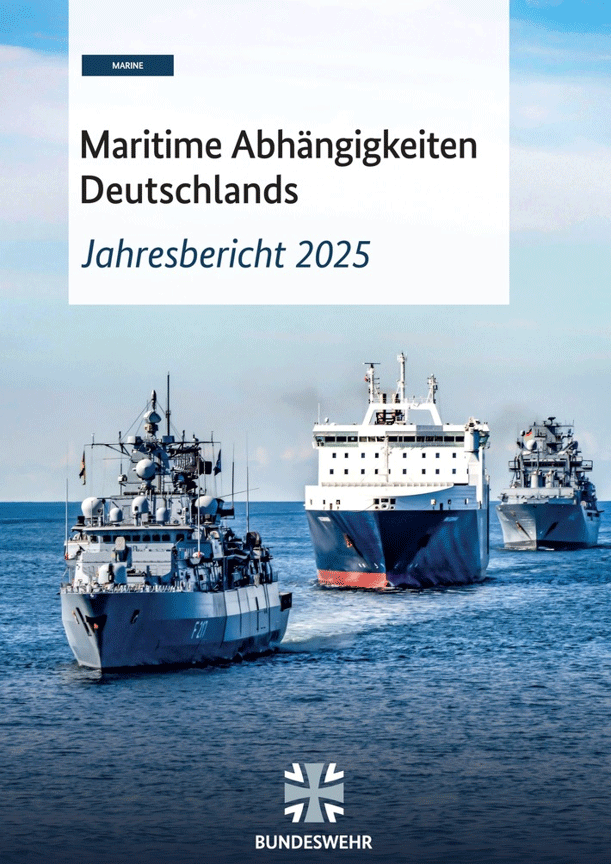
The German Naval Command has published its annual report “Germany’s Maritime Dependencies” for the reporting period 2025. Prepared by the Naval Shipping Directorate in Hamburg, the report compiles analyses and, above all, figures and facts on maritime security, maritime trade, German seaports, global shipbuilding, and the merchant fleet.
The significance of such data for Germany is described by Vice Admiral Axel Deertz, Deputy Inspector of the Navy and Commander of the Fleet, in his greeting: “6,500 nautical miles, three weeks at sea for a cargo ship – that’s the distance between the Strait of Hormuz and the Port of Hamburg. Nevertheless, the effects of attacks on this vital artery of world trade hit us hard and directly in faraway Germany.”
For the first time, this report extends beyond its reporting period to include developments of the current year. The expert contributions also contextualize the strategic competition among major powers in the Arctic and outline the legal options available to counter Russia’s shadow fleet. For Germany, a resource-poor yet heavily export-oriented country, dependence on reliable and secure sea lanes is particularly high. Defense capabilities and deterrence also rely on the dependable arrival of supplies, energy, and goods by sea. The global merchant fleet is therefore a strategic resource for supplying Europe, especially during times of crisis and conflict.
The report generally focuses on the previous year. Its sources—ranging from international organizations and research institutes to port authorities—submit their annual data gradually throughout the following year. Therefore, the 2025 report will not be published until autumn 2026. Developments from the current year are covered in the “Current Events” chapter, starting with this edition.