
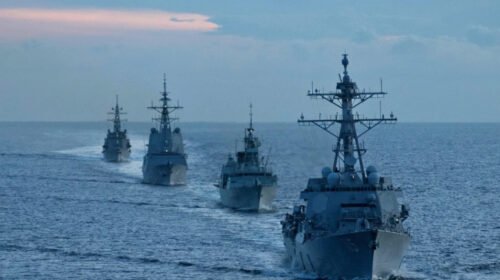

In August and September, Exercise Northern Viking 26 brought together forces from the United States, Denmark, Canada, Norway, France, Belgium, Poland and the host nation Iceland to train the defense of the North Atlantic Ocean and the strategically crucial GIUK corridor between Greenland, Iceland and the United Kingdom.
During the exercise, the Navy’s mine clearance capability, Mine Counter Measures (MCM) Denmark, again worked closely with the Canadian Navy. It is a collaboration that has been strengthened through 2025 and 2026.

Danish Canadian partnership across the Atlantic
Since the end of July, Danish mine clearance specialists and divers from the Navy’s Diving Service have been operating on board a Canadian warship, HMCS Moncton, as part of NATO’s standing mine clearance force (SNMCMG1).
This is far from the first time the Danish and Canadian navies have worked so closely together. The collaboration with the Canadians underlines how well the Danish module concept works across nationalities. The equipment, including a mobile command module in 20-foot containers, remote-controlled sonar drones and advanced underwater robots and sonars for the divers, can be moved from ship to ship, regardless of which country’s flag flies above the deck.
According to the head of MCM Denmark, Commander Kristian Peter Hansen, the cooperation has given both parties a solid benefit. The Canadians have gained insight into the working methods and technology of the Danish capability, while the Danes, on the other hand, have gotten to know Canadian ship operations and procedures from the inside. According to the commander, the mutual learning helps to significantly increase interoperability between the two nations – something that is becoming increasingly important as more NATO countries increase their focus on the protection of critical underwater infrastructure.
Divers on trial in demanding waters
During Northern Viking 26, it was especially the divers from the Navy’s Diving Service who were put to the test. The exercise took place in a demanding maritime environment in the far north, far from the known Danish waters, and thus put the divers’ skills and endurance to a tough test in difficult conditions. At the same time, the bottom conditions around Iceland presented natural challenges, as the Icelandic lava forms some unique contours that are not seen in Denmark.
The Danish divers stepped in, among other things, when the exercise management asked for help to find some remaining practice mines.
“Finding a mine at a depth of 30 meters and defusing it is a highly specialized capacity. But it is one of the capacities that we in the Navy have always been very good at. But the diving training is not just for mine clearance functions – all our ships and naval stations need divers, both constables, sergeants and officers,” says Kristian Peter Hansen.
Gradual build-up
The experience from both the Canadian cruise and the exercise itself will be an important piece in MCM Denmark’s continued development of the modular concept. Over the past few years, work has been done on a gradual build-up of a joint Danish Canadian mine clearance capability, which is scheduled to culminate when Denmark takes over command of NATO’s standing mine clearance force SNMCMG1 2029.
Already next year, the Danish Canadian concept will be expanded with surface drones and side-scan sonars, and the following year, the overall concept, including the Navy Diving Service, will be tested. It will be on board the new Canadian Harry DeWolf class, which are so-called Offshore Patrol Vessels.