
Russia’s unconventional war on Europe has not halted support for Ukraine, but its intelligence services remain a persistent threat. This report examines the campaign, assesses Europe’s response and sets out four scenarios to 2029.
Russia’s unconventional war on Europe has become a test of whether European states can sustain support for Ukraine in the face of a campaign conducted by the Russian intelligence services (RIS) and their proxies. Over the past four years the RIS have targeted European critical infrastructure (ECI–railways, energy networks and defense industries) on which Ukraine’s war effort depends. As part of Russia’s wider campaign, the Kremlin has used sabotage, reconnaissance and intimidation to raise the cost of that support, all below the threshold of armed conflict. In the process, Russia has actively sought to exploit existing divisions within European societies.
Russia’s unconventional war on Europe has so far failed in its strategic purpose. Military assistance to Ukraine continues and European rearmament is under way. IISS data shows that European defense spending grew by 12.6% in real terms in 2025, matching the rate of 2024, while Russia’s rose by 3%. NATO has expanded surveillance of the Baltic Sea and its eastern airspace. The European Union has adopted a Defense Readiness Roadmap and, following a report by Sauli Niinistö, the former president of Finland, on preparedness and readiness of the EU, launched the Preparedness Union Strategy.
National authorities across Europe have expelled intelligence officers, arrested proxies and, in response to specific incidents, closed Russian consulates. National legislation has been updated or created in the aftermath of significant attacks.
Taken together, the measures European governments have imposed have strengthened the ability of national authorities to disrupt Russian operations and limit the consequences of an attack but have not yet demonstrated a sustained deterrent effect. There is no clear evidence that these measures have made sabotage a less attractive instrument of Kremlin policy. To that end, the key question for Europe is whether it can turn a series of national decisions in response to specific incidents into a Europe-wide strategy that constrains Russian action before an operation conducted by the RIS or proxies causes a mass-casualty event or cuts military supply lines to Ukraine. This research paper examines that question and, through four scenarios to 2029, sets out how the threat could develop.
Key Judgements
The Kremlin likely sets priorities for the wider campaign, leaving the RIS to direct individual operations. Activity comes in surges concentrated on strategically important countries and sectors, carried out through layers of intermediaries and proxies.
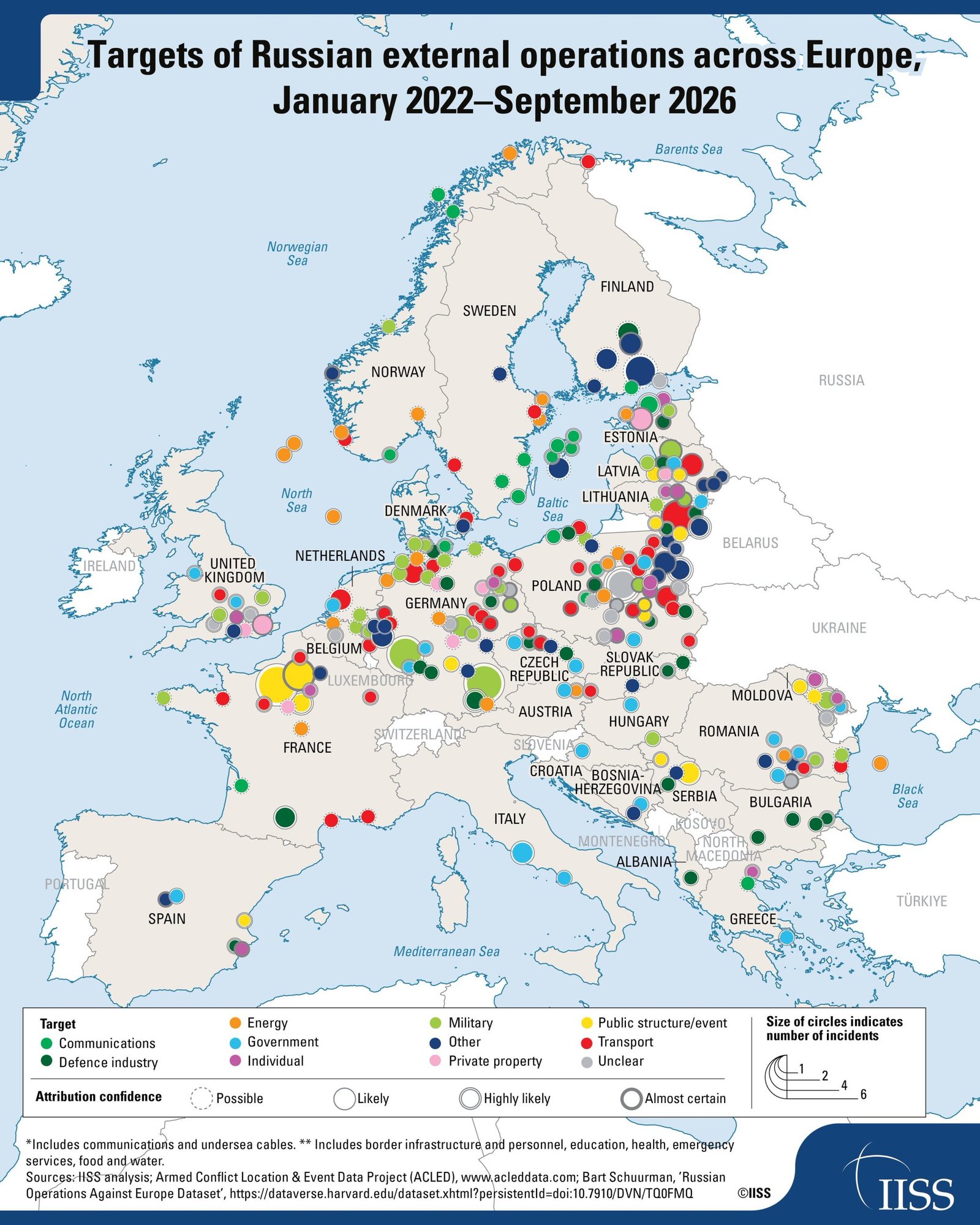
It is highly likely that Germany and Poland will remain the most targeted states. Their transport, logistics and industrial networks are central to supplying Ukraine. Targeting of critical infrastructure (specifically military-industrial and transport) accounted for more than half of recorded incidents between October 2025 and September 2026.
It is highly likely that some Russian proxies have become more capable. Unskilled recruits still carry out most operations. But a semi-skilled tier now uses more complex methods, including improvised explosive devices with timed and remote detonators. Arrests remove proxies but are highly unlikely to deter the RIS that direct them.
Russian sabotage in Europe has increased even as total recorded activity has fallen. In the 12 months to September 2026, sabotage incidents rose by 16%. The use of arson and explosives roughly doubled.
Sabotage has not yet achieved a strategic effect, but a mass-casualty incident is possible as the space for miscalculation narrows. Attacks have damaged ECI and raised the costs of protection, but they have not reduced European support for Ukraine. A single operation that caused fatalities or prolonged disruption would generate demands for retaliation and likely expose divisions between European governments.
European responses to Russia’s unconventional war have imposed some tactical costs, but there is no evidence that they have changed the Kremlin’s calculation. Cross-border investigations offer a route to disrupt recruiters, facilitators and financing. Diplomatic penalties and public attribution have not shown a deterrent effect on Russia’s unconventional war by proxy.
European governments are likely to continue responding to Russia’s unconventional war one incident at a time. Despite recent attacks and attempted attacks in Estonia, Lithuania and Romania, none has set out red lines, with concern about escalation the primary instinct. The effect is that the first mass-casualty attack (deliberate or by miscalculation) would set the terms of Europe’s response, with governments acting under pressure and possibly divided. Publicly signaling, at least among NATO member states, what level of harm triggers which response would give Europe a better chance of changing the Kremlin’s calculation. It would also commit governments in advance to imposing costs on the RIS rather than their expendable proxies, and to sharing the responsibility of protecting supply lines to Ukraine beyond Germany and Poland. The scenarios that follow suggest this is harder to organize than the current approach, but much less dangerous.