
On this day in 1866, two fleets of ironclad warships smashed into each other in the Adriatic, and the side that was outnumbered and outgunned won by doing something everyone thought had died with the ancient world. They rammed.
Here is the setup. Italy and Austria were at war, and Italy had spent a fortune building one of the most powerful navies in Europe, a fleet packed with modern ironclad warships. Austria’s fleet was smaller, older, and lighter, a genuine underdog. The Italians came to seize the Austrian held island of Lissa, and the Austrian admiral, Wilhelm von Tegetthoff, sailed out to stop them knowing the numbers were against him.
Tegetthoff understood he could not win a polite long range gun duel, because the Italian ships were simply better armed. So, he threw out the rulebook and gave his captains one savage, simple instruction. Charge straight in, get among the enemy, and ram everything gray. Turn your own ships into battering rams.
The Italians, meanwhile, handed him a gift. Just as the battle was about to begin, the Italian admiral Persano suddenly decided to switch flagships, climbing off the Re d’Italia and onto a different ship. Fine, except he never told his own captains he had done it. So, at the critical moment half his fleet was looking to a flagship that was empty of its commander, and his battle line stalled and opened a gap right down the middle.
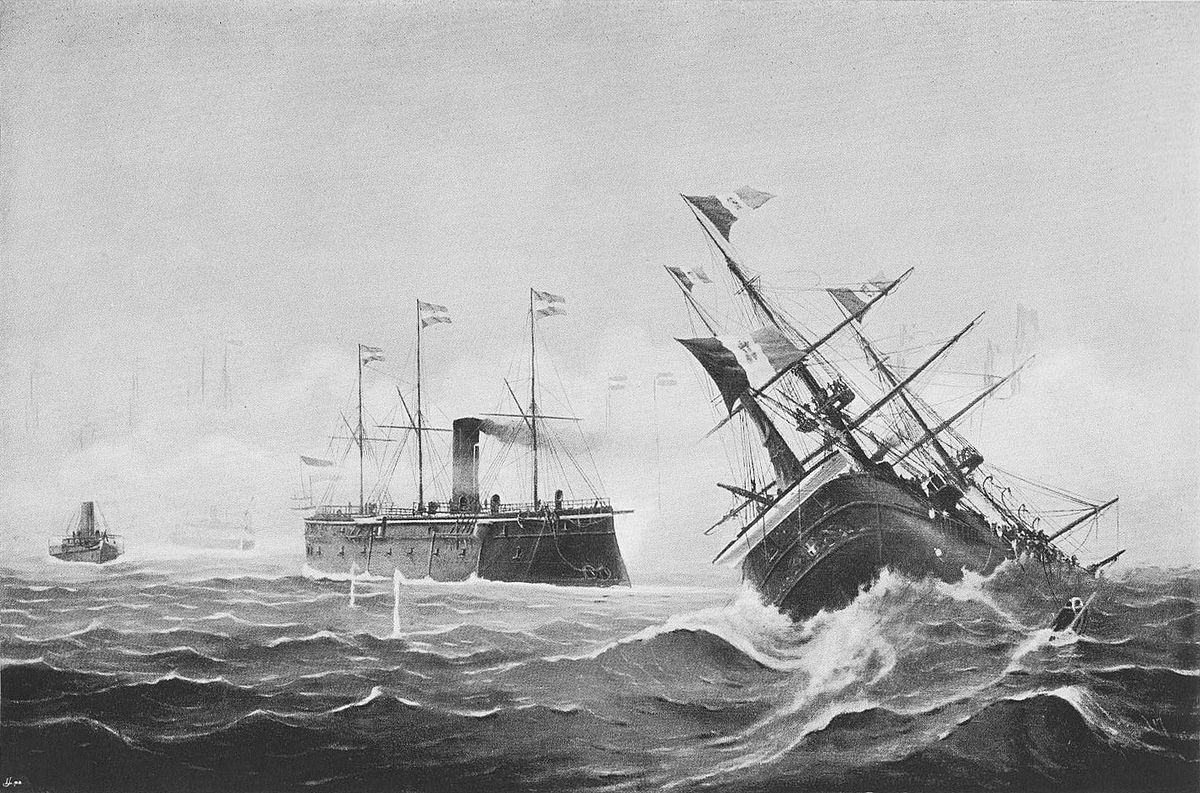
Tegetthoff drove his ironclads straight through that gap and the fight dissolved into a wild, smoke choked brawl at point blank range. And then came the moment that went around the world. Tegetthoff’s own flagship, the Ferdinand Max, lined up on the Re d’Italia, the very ship Persano had just abandoned, and rammed her at full speed. The iron prow tore into her hull, and she rolled over and sank in about two minutes, taking hundreds of men down with her.
That was the battle. The Austrians relieved the island, sank two Italian warships, and lost none of their own. Persano sailed home to a court martial and public disgrace. Tegetthoff became a national hero whose name still rides on warships today.
But Lissa’s biggest legacy was a mistake. Because the ram had worked so spectacularly here, navies around the world spent the next forty years bolting massive iron rams onto the bows of their battleships, convinced this was the future of war at sea. It was not. It was a fluke of one chaotic afternoon, and those rams went on to sink far more friendly ships in peacetime collisions than they ever sank enemies in battle.
Reprinted from Hidden History