
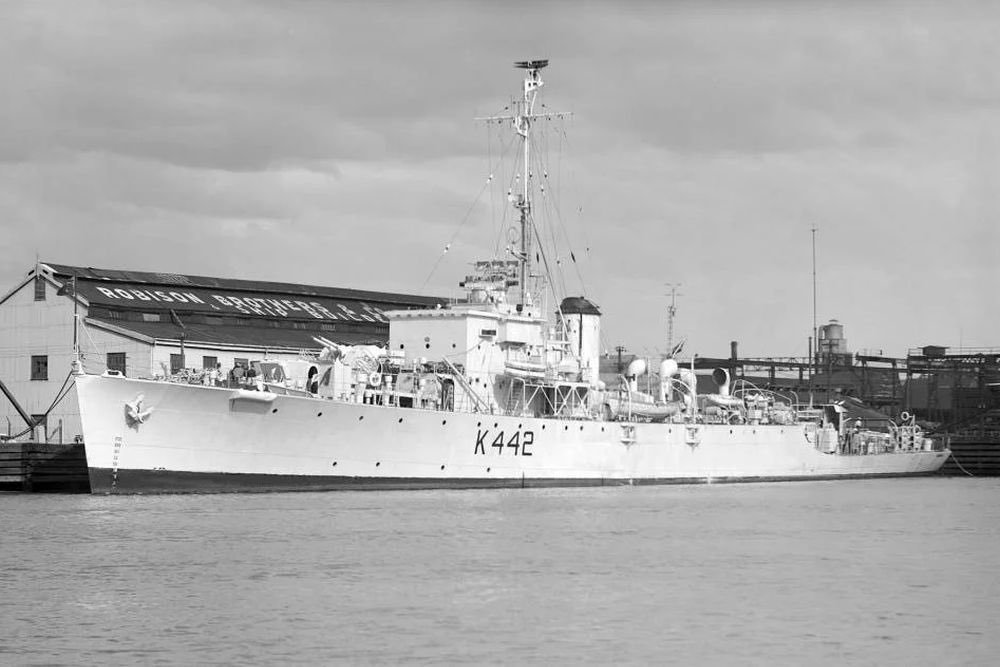
The flat-faced (or more box-like) bridge on Australian Navy River-class frigates was a design modification, mainly on the four “Modified River”/Bay-class equivalents (HMAS Condamine, Culgoa, Murchison, and Shoalhaven), to improve anti-aircraft capability and fire control.
Australia built twelve River-class frigates during WWII (with more ordered but cancelled). The first eight followed the standard British River-class design as anti-submarine escorts (twin-screw “corvettes” scaled up from the Flower class for better range, speed, and seakeeping). These typically had the usual British open bridge.
The final four completed ships (and others planned) were significantly altered for better AA performance in the Pacific theatre. This involved redesigning the bridge structure so the ships could carry:
- Two twin 4-inch QF Mk XVI high-angle/low-angle guns (one forward, one aft).
- A twin 40 mm Bofors.
- Improved fire-control arrangements, including a rangefinder-director (Mark V) on the bridge fitted with Type 285 radar.
These changes produced a more enclosed or differently shaped (often described as flatter or boxier) bridge face compared with the earlier open-bridge Rivers. Related British designs (the Loch class and its Bay-class AA conversions, which used similar simplified wartime construction) emphasized flat panels and reduced curves for easier prefabrication and production. The Australian modifications followed the same practical approach while prioritizing the director and gun arcs needed for dual-purpose AA work.
Standard River-class bridges remained open in typical British escort practice (good all-round visibility for lookouts against both submarines and aircraft). The modified versions sacrificed or relocated some features (e.g., certain bridge-wing gun positions) in favor of the heavier AA battery and director. Later postwar updates to some ships (such as roofed-in bridges) were separate.
In short, the flat-faced bridge was not a cosmetic or purely hydrodynamic choice; it was a wartime adaptation of the bridge structure to support the stronger anti-aircraft armament and fire control fitted to the later Australian River-class frigates.