
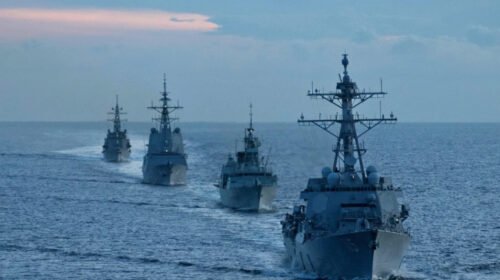


Canada and Australia are natural comparators: sparsely populated, resource-rich, English-speaking Westminster democracies on continent-sized landmasses, with maritime approaches out of all proportion to their populations, economies of similar scale, and defense budgets in the same mid-tier bracket. (From: Defence Connect.)
In the dimensions that bear on naval policy – vast ocean responsibilities, thin populations, constrained industrial bases, dependence on great-power allies – the two rhyme closely.
For 60 years their submarine fleets moved in near-parallel: both operated the British Oberon Class, in similar numbers, retiring them within months of one another around the turn of the century; both then settled at roughly half a dozen conventional submarines, and both are now ageing towards replacement at the same moment (Figure 1).
Yet at the point of recapitalization, they have chosen opposite paths, and the interest of the comparison lies precisely there. Two countries beginning from almost identical positions have reached almost contradictory answers – and no single factor explains why. The divergence is the product of a whole basket of considerations that this essay seeks to surface.
It would be tempting to explain the divergence by geography alone – ice pulling Canada one way, distance pulling Australia the other – but that is too neat and seeing why the central point of this comparison is.
Many considerations bear on a submarine choice at once, and they do not point cleanly in one direction: the physical environment, the assessed severity and timing of the threat, the appetite for cost and schedule risk, the willingness to depend on an ally for sensitive technology, the ambition to build or merely sustain an industry, workforce continuity, the availability of an off-the-shelf design, and domestic fiscal constraints.
For Canada, a tighter fiscal posture, a less urgent threat assessment, mature designs to choose from and the legacy of a failed 1987 nuclear bid may together have made a fast conventional purchase the path of least resistance; for Australia, a more urgent threat assessment, a longstanding ambition to build at home and an offer of nuclear technology that had no Canadian counterpart may have tipped the balance the other way.
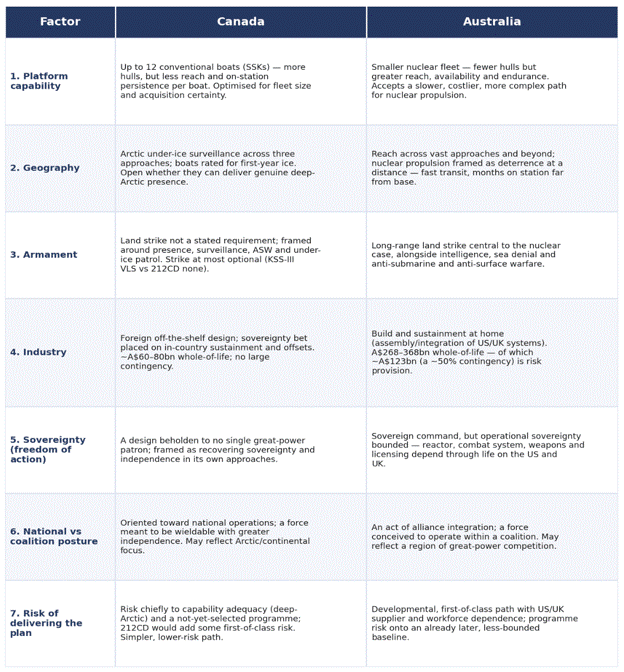
The relative weight of these factors is genuinely uncertain. That two such similar problems produced such different answers suggests the outcome was driven less by any single dominant factor than each country weighed a shared set of considerations – the seven examined below.
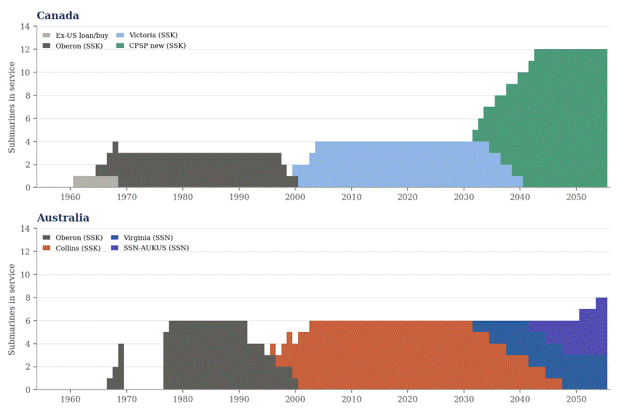
The choices themselves are stark. Canada’s Canadian Patrol Submarine Project (CPSP) seeks up to 12 conventionally powered submarines (SSK) bought largely off the shelf from a foreign yard, having shortlisted Germany’s Type 212CD and South Korea’s KSS-III; the first submarine is required by 2035 and a full fleet by the early to mid-2040s, a clean single-class replacement.
Australia’s AUKUS pathway commits it to a smaller nuclear-powered fleet built ultimately at home to a British design with American technology, bridged by three second-hand United States Virginia Class submarines in the 2030s, with the SSN-AUKUS fleet arriving from the early 2040s and completing in the 2050s.
The consequence is an inversion: for 60 years Australia operated the larger force, but by around 2040, if both programs hold, Canada will field more submarines – and a homogeneous fleet – while Australia manages a complex transition across three classes at once.
Platform capability
A raw hull can mislead, and the first factor is what platforms deliver. Nuclear submarines spend more of their lives available, need not snorkel, and reach distant stations far faster; eight SSNs do not equate to eight conventional submarines in deployable presence.
The inversion in numbers is therefore real but partial: Canada will field more hulls, while the reach and on-station persistence of the two fleets compare quite differently. This is a difference in the character of the forces, not merely their size – and it reflects a deliberate trade.
Australia is accepting a slower, costlier, more complex path to obtain nuclear propulsion and a sovereign build; Canada is optimizing for speed, fleet size and acquisition certainty by buying a proven design abroad. Each is buying down a different risk.
Geography
Behind the platforms lie operational problems similar in structure but different in detail. For Canada, the defining requirement is the Arctic: stealthy, under-ice surveillance across three ocean approaches.
Modern conventional submarines with air-independent propulsion and lithium-ion batteries can loiter submerged for extended periods, and the CPSP requirement is explicit that they operate beneath first-year ice.
Yet a genuine tension deserves naming: the conventional-nuclear gap is arguably widest in the Arctic, where sustained operation beneath deep multi-year ice has historically been the preserve of nuclear submarines – the very rationale for Canada’s abandoned 1987 proposal.
Whether a submarine optimized for first-year ice can deliver genuine deep-Arctic presence – the formal requirement specifies only first-year ice – or whether Canada accepts a real compromise in the deep north remains genuinely contested. For Australia, the defining requirement is reach.
Even confined to its primary area of military interest – the archipelagic approaches, the near-region sea lanes, the trade routes it depends on – the distances are vast, and the interest in holding an adversary at risk further afield larger still.
Australia frames nuclear propulsion as deterrence at a distance: a submarine able to transit quickly and remain on station thousands of kilometers away for months imposes a different calculus on an adversary than a diesel submarine tethered to recharging. The endurance and transit speed of nuclear propulsion are, in this view, not luxury but the point.
Armament
The contrast extends to what the submarines are armed to do. For Australia, long-range strike has become central: holding distant targets at risk is much of the case for the nuclear path and the submarines are built around a substantial land-attack capability alongside intelligence, sea denial and anti-submarine and anti-surface warfare.
For Canada, land strike is not a stated CPSP requirement at all – the project is framed around presence, surveillance, anti-submarine warfare and under-ice patrol – and the point shows up in the gap between the two bids.
The Korean KSS-III carries a vertical launch system able to fire land-attack missiles; the German Type 212CD has none, optimized instead for quiet Arctic patrol.
That a strike-capable design and a strike-less one is both considered fully competitive is itself telling where strike is central to Australia’s case, for Canada it is, at most, an optional attribute of one offer.
And where Canadian commentary values the strike option, it frames it as an alliance contribution rather than a sovereign requirement – the same coalition logic that arguably underlies much of Australia’s strike capability, even though Australia presents it as sovereign deterrence.
The difference is as much in how each classifies the capability as in the capability itself.
Industry
Both programs are as industrial undertaking as military ones. Canada has chosen a foreign off-the-shelf design but made domestic participation – in-country sustainment, technology transfer, local supply-chain development – a near-decisive criterion; its competition has become a contest of industrial offset packages as much as of platforms.
Canada’s sovereignty bet is therefore placed largely on sustainment. Australia’s is placed on construction and sustainment together: the Australian optimal pathway commits to building SSN-AUKUS at Osborne, standing up a domestic nuclear-submarine industry almost from a standing start – though even the domestic build is in substance an assembly-and-integration capability, since the reactor, combat system, sensors and weapons come from the United Kingdom and the United States.
The cost of this ambition is substantial and hard to compare cleanly. Australia’s headline $268–368 billion is a whole-of-life figure spanning three decades. Much of it is not the cost of submarines as such.
Of the top-line figure, roughly $123 billion – a contingency near 50 per cent, where most projects carry five to 10 per cent – is risk provision, itself an acknowledgement that the cost cannot yet be bounded with confidence.
A further large share is deliberate investment in industrial capability and payments into the United Kingdom and United States submarine industrial bases. Canada’s program, valued at around $60–80 billion, including decades of sustainment (the most-cited life cycle figure is about CA$60 billion), carries neither a comparable contingency nor an industry support component, because it buys an in-production foreign design rather than building an industry to produce it.
The gap of several times over is real, but it reflects an explicit Australian policy choice rather than a like-for-like difference in the price of the submarines.
Sovereignty as freedom of action
Sovereignty, understood here as freedom of action, is how far each country can, in practice, operate its submarines as it sees fit. It helps to distinguish between three dimensions the debate often runs together.
Build sovereignty is the ability to construct – in practice, to assemble and integrate – the platform at home. Sustainment sovereignty is the ability to maintain and upgrade it through life. Operational sovereignty is the ability to use it independently – and it is not binary. Australia would retain sovereign command of its submarines and sovereign decisions over their employment, and allied assurances on this are emphatic; but command is not the same as unconstrained latitude.
The reactor, much of the combat system, and the weapons originate with and depend through life upon the United States and the United Kingdom. And although AUKUS has relaxed defense-trade controls, significant elements of the technology remain under separate licensing, so the flow of information needed to operate and sustain the submarines is not unconditionally free.
To this technical dependence, critics add a political one – that the value Australia places on preserving the arrangement may itself narrow the band of independent action where preferences diverge.
Defenders respond that command and employment remain sovereign and that deep interoperability is the point, not a defect. Operational sovereignty over such a platform is therefore best understood as bounded rather than absolute.
The Canadian case throws this into relief, because there sovereignty sits on the opposite side of the ledger: Canadian commentary presents the submarine program as a means of recovering sovereignty – of reducing a present dependence on the United States for surveillance in its own waters and restoring independence in its approaches – by choosing a European or Asian design beholden to no single great-power patron for its most sensitive systems.
Canada has its own unresolved tension, whether a submarine optimized for limited periods under ice can deliver the independent Arctic presence the argument promises; but the framing is the mirror image of Australia’s: for Canada, sovereignty is a prize to be regained; for Australia, a necessary and accepted bound on a capability judged worth it.
National v coalition posture
The sixth factor is distinct from the fifth: not how freely each could act alone, but whether each has built its force for unilateral national operations or as a contribution to a coalition. Here the difference is one of kind rather than degree. Australia’s submarine decision is not solely a capability acquisition; it is an act of alliance integration.
To operate nuclear submarines, Australia is binding itself into the undersea-warfare ecosystems of the United States and the United Kingdom – their training pipelines, nuclear stewardship and regulation, combat systems, weapons and industrial bases – and some Australian policymakers regard that embedding as a strategic objective in its own right, a force conceived from the outset to operate as part of an allied whole.
Canada’s program is oriented more towards national operations: principally a capability acquisition, with some analysts reading its choice of a non-American supplier, at a moment of visible Canada–US friction, as deliberate hedging – a force meant to be operable with a greater measure of independence from any single patron. The two have therefore answered a prior question differently.
Australia has chosen, deliberately, to field a force whose value is realized largely within a coalition; Canada has leaned towards one it can wield more on its own. Neither posture is the more sovereign in the abstract; there are different bets about whether a middle power’s submarines are most useful acting with allies or acting alone.
That divergence may reflect geography as much as policy: Australia’s principal strategic challenge lies within a region of intensifying great-power competition, where plugging into allied strength has its own logic, while Canada’s primary concerns remain Arctic sovereignty and continental defense alongside the United States, where a capability it can wield more independently has its own logic.
Risk of delivering the plan
This factor stands apart from the first six: those compare what each country obtains if its plan succeeds. This factor considers whether the plan will be achieved and the risk falls unevenly, compounding choices already made.
Australia has, by deliberate choice, already accepted a later capability and a less certain cost. Its strategic guidance is the most urgent of the two, judging the outlook the most demanding since the Second World War; yet its principal capability arrives only in the 2040s, the interim Virginias an implicit acknowledgement that it comes late relative to the threat the strategy describes.
Canada’s less urgent posture, framed around sovereignty, Arctic presence and avoiding a capability gap, fits its faster off-the-shelf acquisition more closely. So, the country with the more urgent strategy has, even on schedule, chosen the slower-arriving capability – and has likewise recognized that its cost cannot yet be well bounded, provisioning a contingency near 50 per cent of the headline figure where most projects carry five to 10.
The contingency is itself Australia’s own acknowledgement of that uncertainty. Onto these already-stretched baselines the execution risk then bears, and it bears asymmetrically.
Australia’s is the developmental path: a first-of-class submarine, a new reactor integration and combat system, a yard standing up nuclear construction from a low base, dependence on a United States production line already below its own navy’s needs and on a United Kingdom enterprise whose own parliamentary committee reported in 2026 that its single build yard had slipped and naval availability was critically low; and a workforce that must grow several-fold in skills the country does not yet possess.
Canada is not without risk, but its risks are of a different kind: whether a submarine optimized for first-year ice can deliver genuine deep-Arctic presence, a workforce expansion from a low base, dependence on a single foreign builder’s line, and a program on which no design has yet been selected (a decision is expected in 2026) – and, in the German option, a design maturity question of its own.
The choice between the shortlisted designs itself shapes the risk: the Korean KSS-III is already in service and in production, while the German Type 212CD, though derived from a proven class is, in substance, a new design carrying first-of-class risk of its own. So even Canada’s conventional path spans a maturity range, though either option remains far short of the first-of-class burden Australia carries.
Canada’s risks bear chiefly on capability adequacy and on a not-yet-started schedule; Australia’s bear on a schedule and a cost it has already stretched.
In effect, each has accepted a different kind of risk: Australia – greater program risk in pursuit of greater capability; Canada – some uncertainty over capability adequacy in exchange for a simpler, bounded cost, lower-risk program.
John Harvey is a former Air Marshal in the Royal Australian Air Force and has a PhD in computer science from UNSW Canberra. His postings have included Chief Capability Development Group, F-35 project manager, director Military Strategy and director Air Power Studies Center.