
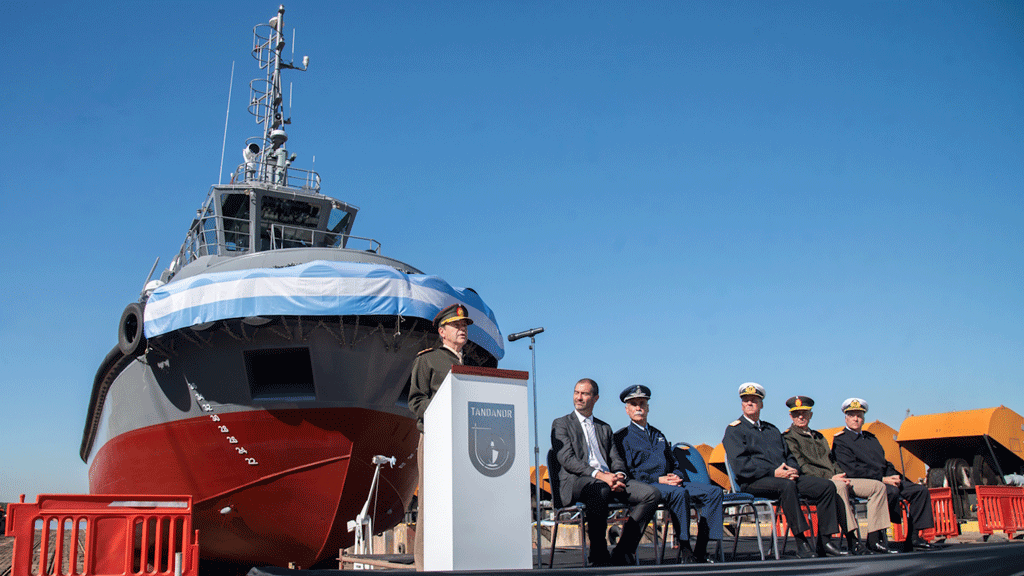
Named ARA “Pampero” and with María Cristina Brown de Racedo as godmother, a direct descendant of Admiral Guillermo Brown, the father of the nation at sea, the launching ceremony of the unit was held at the Tandanor Shipyard, which begins its phase of sea and port tests, after which it will be incorporated into operational service.
In his remarks, the Minister of Defense, Lieutenant General Carlos Alberto Presti, stated: “The Ministry of Defense acts as a system that integrates its Armed Forces and other agencies. This coordination ensures that defense operates as a whole; it is the expression of a common purpose. This integration is the standard we must consolidate collaborative work between the State, its industry, and the Armed Forces, supported by human capital—the men and women who design and build these vessels.”
In that regard, he added that “The Pampero tugboat strengthens the naval system, improves logistical support, and expands the deployment of our forces, also projecting security over supply chains, sustainment in Antarctica, and deployments for control over our sea. This tugboat gives us freedom of action, decision-making capacity, and autonomy to fulfill our mission. Argentina is a maritime nation, with areas that demand an effective presence. That presence is built with organization and concrete resources: this tugboat reinforces it.”
Finally, he emphasized that “Argentina is moving towards a development that demands protecting its resources and sustaining its strategic projection. In a dynamic international scenario, critical media acquire central value. Developing and maintaining our own resources constitutes a strategic decision for the Argentine Republic. The course is clear: to strengthen the military and consolidate Argentina’s presence in our sea. Argentina is building the future, transforming its decisions into concrete actions. I want to especially thank the Argentine Navy, the President of Tandanor, and all the authorities, particularly the Tandanor workers, for their vision, for their effort and dedication,” he concluded.
From an often overlooked but crucial role in the naval sphere, tugboats provide an essential service for the safe movement of vessels. Their efficiency and optimized response times ensure the rapid deployment of operational units ready for navigation, guaranteeing safe operations during movements and maneuvers, and assisting military vessels entering and leaving the dock.
Furthermore, the presence of domestically owned tugboats strengthens the Argentine Navy’s logistical autonomy, with the added benefit of having been designed and built within the country. This reduces dependence on external services and allows the Navy to maintain port operations under its own control, even in demanding or restricted situations.
Following launch, Pampero will begin a period of port and sea trials to thoroughly test all its systems. Its entry into operational service is scheduled for the second half of the year, starting in June.
Those participating in the event alongside Minister Presti included the Secretary of Research, Industrial Policy and Production for Defense, Mario Katzenell; the Secretary of International Affairs for Defense, Daniel Martella; the Chief of the Joint Chiefs of Staff of the Armed Forces, Admiral Marcelo Alejandro Dalle Nogare; the Chiefs of Staff of the Argentine Army, Lieutenant General Oscar Santiago Zarich; the Argentine Navy, Admiral Juan Carlos Romay; and the Argentine Air Force, Brigadier General Gustavo Javier Valverde; the President of Tandanor, Tomás Etcheverry; authorities and members of agencies of the Ministry of Defense; and national and provincial military and civilian authorities.
ARA Pampero in Detail
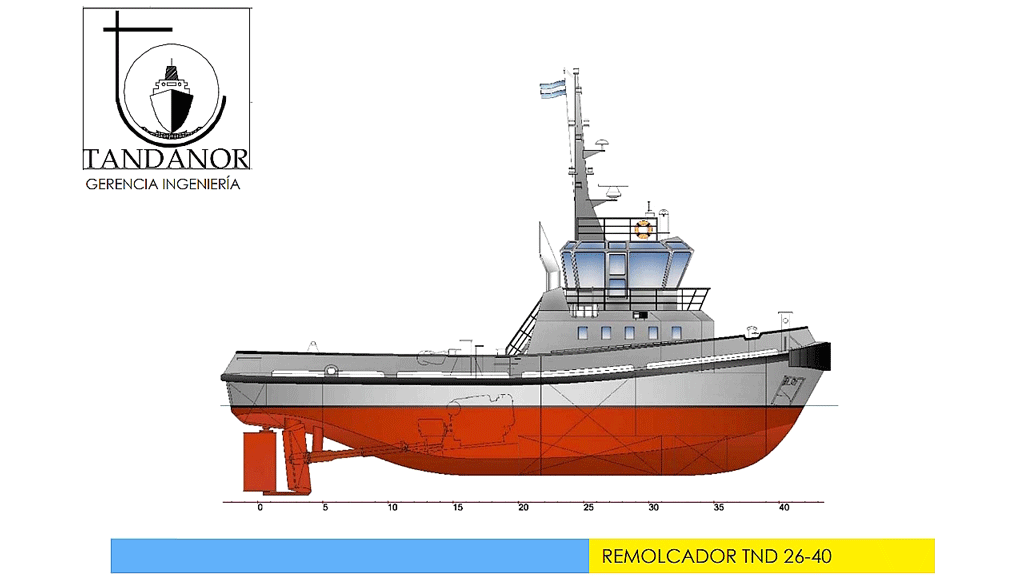
Its main dimensions are 25.7 m in length; 8.4 m in beam; and 4.1 m from its main deck to the keel or lower section (depth). Its primary capacity lies in its 40-ton towing capacity (bollard pull), thanks to propulsion provided by two engines, each delivering 1650 HP. It has fuel capacities of 71.5 m³; 12 m³ of fresh water; 1.7 m³ of lubricating oil; 1.9 m³ of black water; 2.2 m³ of bilge water; 1 m³ of slop; and 1.5 m³ of used oil.
It also features 100 kVA 230 V/400 V / 50 Hz generator sets; a 360 HP fire pump; a fire pump monitor on the wheelhouse; a box cooler cooling system; a diaphragm sewage pump; and 20 m³/h general service pumps. On deck, there is a 40-ton towing hook; a winch for two 360 kg anchors (APA); and D-type rubber fenders on the sides and W-type fenders on the bow. Special attention was paid to habitability, as it includes cabins for the captain and chief engineer, and accommodations for six crew members, as well as a galley and mess.
The unit’s navigational safety is ensured by its fixed radar equipment; maritime GPS; depth sounder; nautical compass for positioning; very high frequency (VHF) and single sideband (SSB) maritime communication equipment; EPIRB emergency beacon; and automatic identification system (AIS) module.