
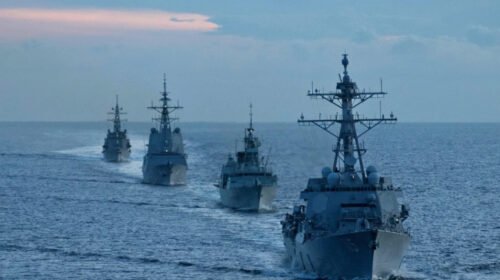
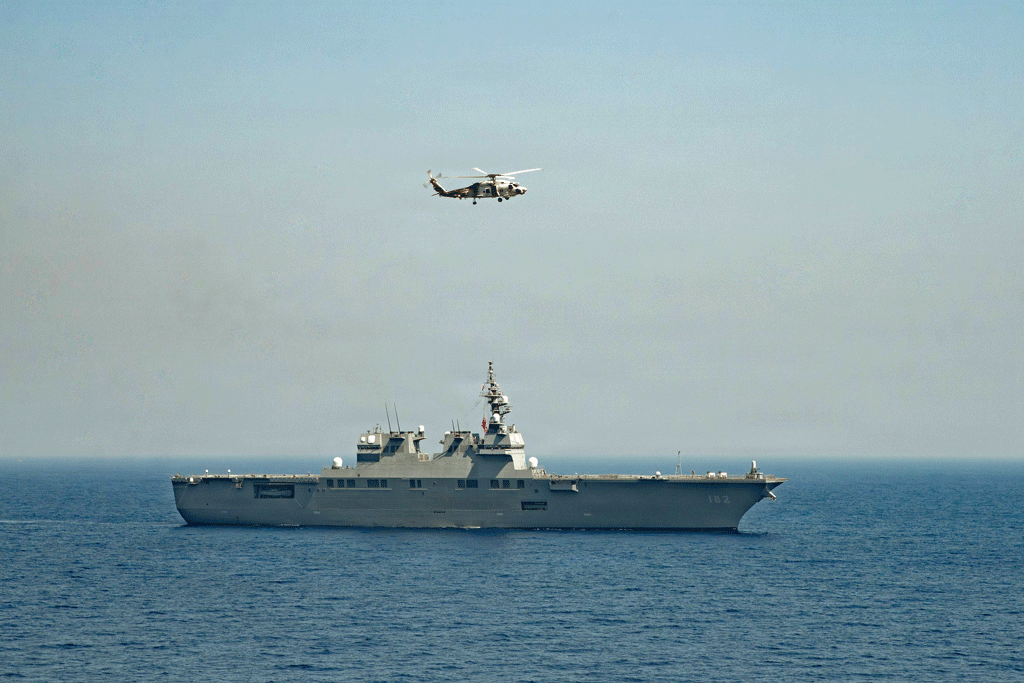
The Philippines, United States, Australia, Japan, and Canada conducted a Multilateral Maritime Event off the western coast of Luzon as part of Exercise Balikatan 2026, April 23 – May 1.
The MME featured training in live-fire gunnery, anti-submarine warfare, search and rescue, and replenishment at sea as well as deck landing qualifications for rotary wing aircraft to enhance interoperability and operational readiness among participating forces.
“Each year, Balikatan evolves with the growing demands of the maritime environment,” said U.S. Navy Capt. John Baggett, commodore of DESRON 7. “This year was no different. The strength of our partnerships throughout the region was on full display as 11 ships, eight aircraft and several thousand Sailors, Marines and Coastguardsmen from around the Pacific stood shoulder-to-shoulder, increasing our lethality, expanding our interoperability, and working together to ensure a free and open Indo-Pacific region.”
Eleven vessels representing five nations joined the exercise:
- United States: U.S. Navy Whidbey Island-class amphibious dock landing ship USS Ashland (LSD 48) and U.S. Coast Guard Legend-class cutter USCGC Midgett (WMSL 757).
- Philippines: Philippine Navy landing platform dock BRP Tarlac (LD601), Miguel Malvar-class guided-missile frigate BRP Miguel Malvar (FFG06), and Jose Rizal-class guided-missile frigate BRP Antonio Luna (FFG15) and Philippine Coast Guard BRP Cape San Agustin (MRRV 4408).
- Australia: Royal Australian Navy Anzac-class frigate HMAS Toowoomba (FFH 156).
- Japan: Japan Maritime Self-Defense Force Hyuga-class helicopter destroyer JS Ise (DDH 182), Murasame-class destroyer JS Ikazuchi (DD 107), and Osumi-class tank-landing ship JS Shimokita (LST 4002).
- Canada: Royal Canadian Navy Halifax-class frigate HMCS Charlottetown (FFH 339).
“Participating in this exercise is very important because it builds trust and confidence with our partners and allied nations,” said Philippine Navy Lt. j.g. Emmanual Leron, Philippine Navy liaison naval officer to the USS Ashland for the MME. “How we approach conducting these kinds of exercises together builds synergy and partnership, and we get to know more about each other. It shows that all these allies and partner nations have the shared values, interests, and responsibility for maintaining peace and security in the Indo-Pacific region.”
The successful completion of the MME serves as a testament to the exercise’s expanding multilateral cooperation and reinforces our shared commitment to a free and open Indo-Pacific.