
By Rebecca L. Grant, Ph.D.
Lexington Institute
Operations in the Caribbean are yet more proof that amphibious forces will be in high demand.
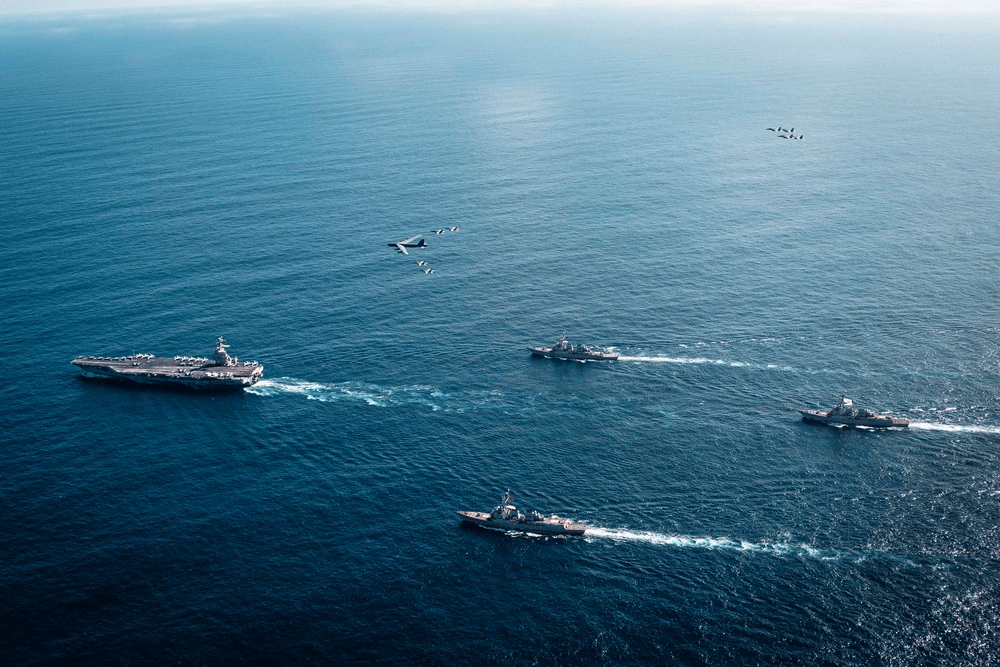
In late November, all eyes were on the aircraft carrier USS Gerald R. Ford, racing from the Mediterranean to the Caribbean to join Operation Southern Spear and help put the squeeze on Venezuela’s illicit money machine.
But the USS Iwo Jima Amphibious Ready Group (ARG) was already on scene. “Our integrated Navy-Marine Corps warfighters are ready to execute the nation’s business and deliver quick and decisive combat power no matter where we are tasked in today’s complex global environment,” said Capt. Chris Farricker, commodore, Amphibious Squadron 8, as the USS Iwo Jima Amphibious Ready Group (ARG) departed Norfolk, Virginia back on Aug. 15.
Embarked with the Iwo Jima ARG was the 22nd Marine Expeditionary Unit, a special-operations capable unit with formidable capabilities for “a wide variety of contingency missions,” as the Navy terms it. Operation Southern Spear has included interdiction of drug boats and the capture of two Very Large Crude Carrier tankers.
The Venezuela deployment is yet more proof that amphibious forces will be in high demand from the first shifts in policy through the full span of operations. Their vital role in the Middle East, Europe and the Pacific was already confirmed. Commandant of the Marine Corps General Eric Smith pointed out last month that America’s national security requires a “return to a 3.0 ARG/MEU presence: three forward-postured MEUs, each with three amphibious warships, persistently positioned around the globe.” As Smith said, “this has long been the standard, and it remains the Marine Corps’ North Star.”
The USS Iwo Jima’s leading role is a positive sign for the amphibious fleet. Generating combat power depends on readiness and the Navy’s amphibious ships have been through a rough patch, with amphibious ship readiness levels at times below 50%. When the USS Boxer Amphibious Ready Group was set to deploy from the West Coast in early 2024, the three ships had to stagger their departures due to delayed maintenance. The USS Somerset sailed in January; the USS Harpers Ferry left in March and Boxer departed in April. Boxer was at sea only one week before a broken starboard rudder brought caused the ship to return home – for three months.
That was one of the many indicators telling the Navy to search for innovative approaches to speed up maintenance. “I want to maximize the availability of our amphibious ships, and I’ve done poorly in that, particularly in the Wasp and Boxer deployments,” acting chief of naval operations Adm. Jim Kilby told the House Armed Services Committee in June 2025. “I’m committed to getting our amphibious maintenance done on time so the Marines can embark and we can deploy as scheduled for the global force management process,” Kilby said.
Fortunately, the Navy has invested in innovative approaches and welcomed partnerships with industry. And it is beginning to pay off. Industry is beginning to provide solutions to get ships back in the water more quickly.
Take the example of the Dock Landing Ships of the USS Whidbey Island (LSD 41) and USS Harpers Ferry (LSD 49) classes. These ships carry the Landing Craft Air Cushion (LCAC) hovercraft that put Marines ashore. “No beach out of reach” is the motto. First built in the mid-1980s and mid-1990s, these ships were hit hard by the combination of midlife maintenance and high operating tempo.
Focusing ahead on parts availability can significantly reduce maintenance downtime for U.S. Navy ship engines. The U.S. Navy initiated a pilot program called ‘Pitstop,’ an innovative approach to engine maintenance and overhaul. Pitstop targeted four LSD-class ships where frequent maintenance delays had led to cost overruns and delayed repairs. In the “open and inspect” approach to engine overhaul, the ship enters dry dock, its engines are opened for inspection, and then the needed parts are ordered. However, parts delays extended the maintenance period by weeks and months.
The Pitstop program put together a standardized, pre-certified kit of OEM component parts. In parts were sourced from the decommissioned USS Whidbey Island to transfer into the kit for USS Ashland. Like NASCAR pit crews, where everything needed is instantly at hand, Pitstop streamlines the process, increasing ship readiness and combat capabilities. The Pitstop strategy focuses on a precise 30-day window and has achieved a 60% faster maintenance turnaround, according to industry partner Fairbanks Morse Defense. Pitstop has delivered impressive results on both Ship’s Service Diesel Generator (SSDG) and Main Propulsion Diesel Engine (MPDE) for USS Gunston Hall (LSD 44), USS Ashland (LSD 48), USS Oak Hill (LSD 51), and USS Pearl Harbor (LSD 52).
AI has its place, too. The destroyer USS Fitzgerald deployed with Enterprise Remote Monitoring Version 4 (ERM v4), an artificial intelligence system to help crews identify equipment failures before they occur, reducing maintenance disruptions. ERM v4 is a part of the Pentagon’s Condition Based Maintenance Plus initiative, which aims to use machine learning to enhance maintenance planning for ship crews, shore commands, and logistical units.
The time is right for other operational innovations. Currently, the ship’s force is not typically integrated into shipyard maintenance, but it should be incorporated to expedite work and build greater skills in responding to minor engine and equipment casualties at sea.
Sailor-led maintenance and repair while at sea is one component of readiness. However, shifting to major maintenance such as engine rebuilds while underway is not the answer. Ship crews have extraordinary engineers, but often lack OEM capabilities, expertise, spare parts, and capacity to address complex maintenance repairs. Maintenance at sea introduces tremendous vulnerabilities, as well as limited capacity to tackle the most challenging repairs for ships. Rough sea state, high OPTEMPO, and the vulnerability of a ship attempting to conduct a major repair in or near a combat zone (where maneuverability is life), further complicate the situation.
Then there is manning. In January 2025, the GAO reported that Executive Officers said it was “moderately to extremely difficult to conduct repairs while underway with the number of sailors assigned to their ships.”
To keep the surface fleet ready, shipyards at home and overseas need to apply the lessons of programs like Pitstop and focus on the factors delaying maintenance. Expanding the U.S. Navy’s network of shipyards – particularly in the Pacific – can enable highly capable partners, such as Japan, South Korea, Singapore, and Australia, to contribute. On September 30, the USNS ALAN SHEPARD, a Military Sealift Command vessel, arrived at HD Hyundai’s dock in South Korea for maintenance, repair, and overhaul.
Innovative maintenance will help keep the fleet ready – for the Western Hemisphere and beyond.