

NEW | SPECIAL REPORT: The Kremlin is conducting a coordinated series of kinetic campaigns targeting Europe, and NATO states must understand and forthrightly discuss both these ongoing Russian campaigns against Europe and the evolving character of the near-term Russian conventional threat.
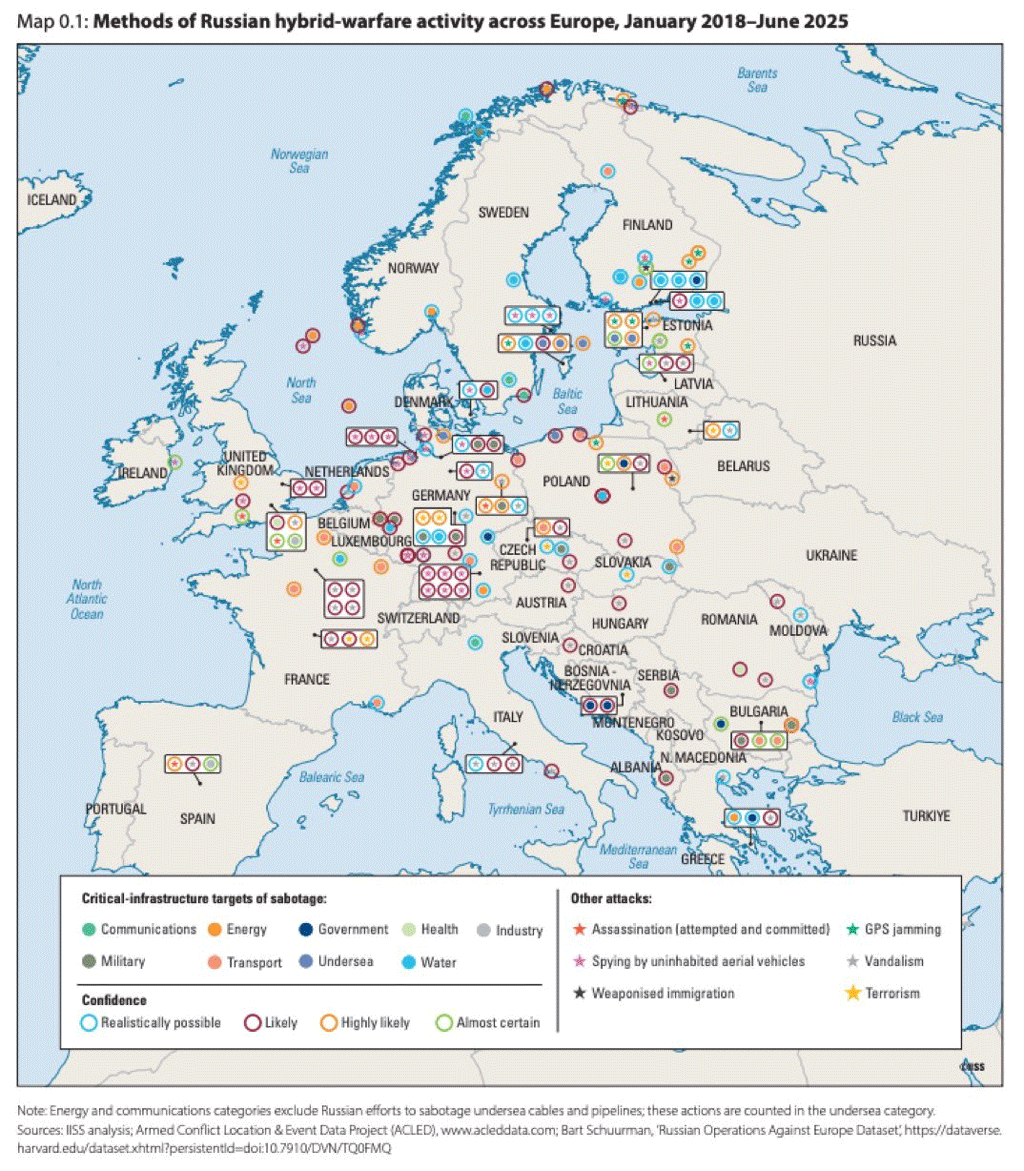
The Russian government has long considered itself to be in a long-term conflict with the West — a conflict it has recently escalated through a coordinated series of kinetic campaigns against European targets beyond Ukraine. European states must both understand internally and publicly name these campaigns for what they are: coordinated kinetic and non-kinetic attacks against NATO military and civilian targets, not isolated incidents or “provocations.”
European officials’ increased willingness to publicly discuss Russia’s kinetic campaigns is positive, but much of the language NATO and individual European states use to discuss the ongoing Russian campaigns still obfuscates the coordinated and coherent nature of the Russian efforts.
NATO must additionally prepare for the possibility of near-term conventional Russian attacks that would not be militarily existential to NATO but could be politically existential by dividing NATO, and on a timeline faster than those that many European officials currently orient themselves on.
NATO and European states require a shared understanding of the problem to design and execute coordinated policies to defeat ongoing Russian kinetic campaigns and deter the Russian conventional threat. NATO and European states have three overall tasks.
First, NATO and Europe must understand and respond to the ongoing Russian kinetic campaigns against Europe and must use clear language when communicating about Russian actions to facilitate prompt and meaningful responses.
Second, NATO and Europe must rapidly accelerate efforts to forecast and prepare for the risk of a potential near-term limited Russian conventional attack that NATO is not yet sufficiently taking into account.
Third, NATO and Europe must improve ongoing efforts to leverage lessons from Ukraine and forecasts of the changing character of war and strengthen NATO’s ability to deter or defeat the evolving conventional Russian military threat.
These three challenges are interlinked and must be taken as a whole. Open, clear-eyed, and prompt discussion of potential European policy responses are essential to respond to the ongoing Russian threat and the risk of further Russian actions to test or directly attack NATO.
The Russian military could conduct air, missile, or drone strikes or a limited ground incursion against one or more Baltic states to test and seek to break NATO’s resolve to invoke Article 5 and respond effectively on its basis.
A limited Russian attack would aim to create a situation in which NATO is unable to agree how, or if at all, to respond to a Russian attack. Any near-term Russian conventional attack would be tailored to maximize the possibility that NATO states would fail to unify and provide military assistance as an alliance to an attacked member state.
A scenario in which NATO does not unanimously vote to honor an invocation of the Article 5 mutual defense clause, or in which a state under Russian attack declines to invoke Article 5 at all out of concern that it would not receive unified support, would significantly damage NATO’s credibility and unity — an outcome that would achieve a longstanding Russian objective and immensely expand Putin’s space to maneuver and plan future attacks against a divided alliance.