

A significant milestone towards arming Royal Navy maritime attack helicopters with ship-busting missiles has been achieved.
Initial Operating Capability (IOC) has been met for the anti-ship Sea Venom missile, meaning it can now be deployed with Wildcat helicopters on front-line duties.
A Wildcat can carry up to four Sea Venoms, giving it the ability to strike multiple targets in a single sortie or unleashing a salvo against one target.
It carries enough destructive power to target larger warships – like corvettes and patrol ships – while the Wildcat also carries the lightweight Martlet missile for taking out boat swarms and smaller vessels.
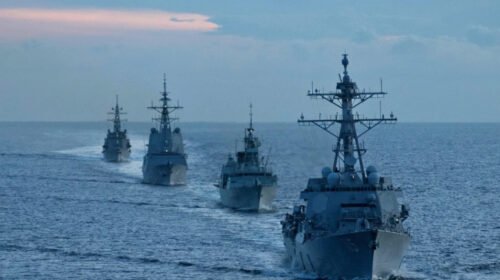
IOC was achieved during Operation Highmast – the Royal Navy’s global mission to the Indo-Pacific led by flagship HMS Prince of Wales.
Four Wildcats from 815 Naval Air Squadron are armed with Sea Venom on the deployment, spread across the Carrier Strike Group on carrier HMS Prince of Wales, destroyer HMS Dauntless and Norwegian frigate Roald Amundsen.
Commanding Officer of 815 Naval Air Squadron, Commander James Woods, said: “The introduction of Sea Venom is a step-change in our combat power.
“It delivers a lethal combination of precision, reach, and flexibility that allows us to strike decisively against a wide spectrum of threats in the maritime, coastal, and land domains.
“Most importantly, it gives us the ability to neutralize those threats at range. This is a transformational capability for the Fleet Air Arm, and ensures that we are ready to defend and protect NATO and Allied interests at home and abroad.”
Sea Venom provides the long-range armament of the Future Anti-Surface Guided Weapon (FASGW) programme, with the short-range capability delivered by the Martlet missile, which is already in service.
It is an advanced weapon, which can utilize an ‘operator-in-the-loop’, who can make real-time adjustments mid-flight to control the trajectory of the missile.