
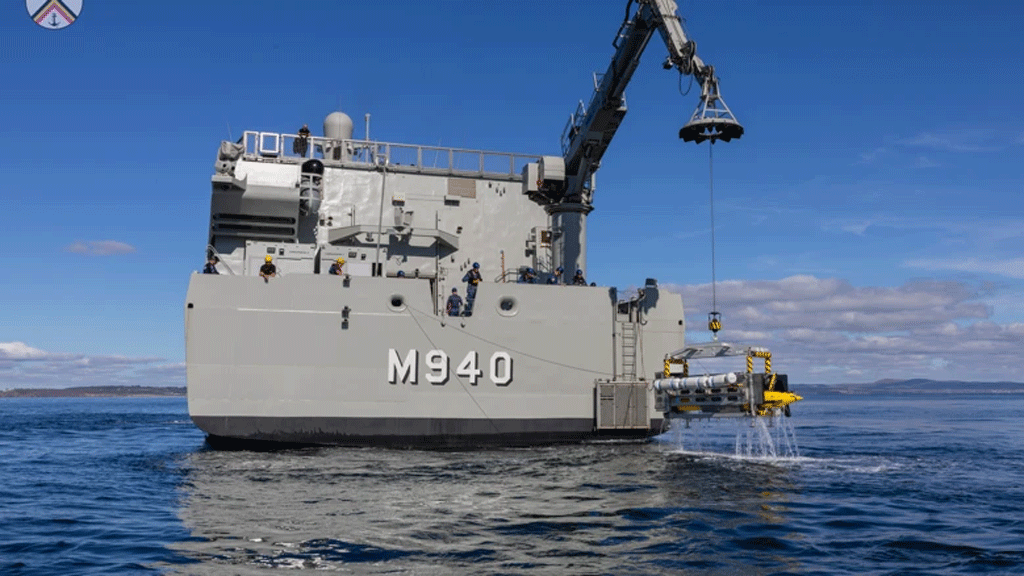
M940 Oostende continued its operational build-up during a three-week training exercise in the Bay of Douarnenez, near Brest. The latest-generation minehunter made use of the Toolbox during this exercise: a suite of drones and autonomous vehicles (USVs) that form the core of the future Belgian-Dutch mine countermeasures capability.
Whereas minehunters previously sailed through suspicious zones at low speed to intervene on the spot, the new generation of ships, to which the Oostende and the Tournai belong, remain at a safe distance, and various drones are deployed for most operations.
The operators program the trajectory of USV Inspector 125 in a specific area. As soon as the drone platform is launched, the USV starts the sequence: sailing to the starting position, deploying the drones, subsequently retrieving them, and simultaneously maintaining communication between the drones and the ship. From there, the operator can monitor the autonomous mission and, in the case of the Seascan for example, view the images live.
The quiet bay of Douarnenez
Beneath a mirror-smooth water surface, in the largest Breton inlet, lie various French Navy practice mines at an average depth of thirty meters, along with three particularly interesting wrecks. An ideal terrain to evaluate the new systems and further refine procedures.
“We train hard to achieve an operational level that closely aligns with reality. Today, we have even more detailed images at our disposal than before. And naturally, I am proud when I spot such a practice mine myself,” explains Second Master Romain.
A look at the Toolbox
The Oostende can carry two Inspector 125 USVs on board. Depending on the mission, these drones can transport various systems. One of these is the A18, an autonomous underwater drone that detects mines using its sonar. The T18, which is towed by a USV, makes it possible to analyze the images in real time from the mothership.
When a suspicious contact is detected, a drone equipped with an optical camera is deployed to accurately identify it. Finally, if neutralization is required, the K-STER drone can be sent to the target to destroy the mine remotely.
A fleet of six ships
The Oostende, built by Naval Group, is the first multi-purpose platform of its class. Like the Netherlands, Belgium ordered six ships. The second ship for Belgium, the Tournai, arrived at the naval base in September.
With the Port of Rotterdam and the Port of Antwerp-Bruges as strategic gateways to Europe, mine countermeasures remain of the utmost importance for the Netherlands and Belgium.