
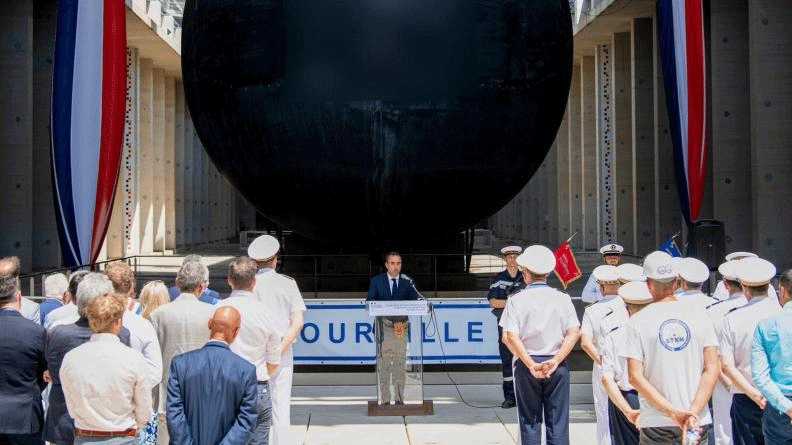
On July 4, the Minister of the Armed Forces, Sébastien Lecornu, inaugurated the new Missiessy Dock No. 2 in Toulon—a mammoth construction project to accommodate the new Suffren-class nuclear attack submarines (SSNs). On this occasion, the SSN Tourville was commissioned into active service.
It’s a titanic, discreet project, hidden away within the confines of the Toulon military port. A €3 billion project, spread over fifteen years. “29,000 cubic meters of concrete, 55 kilometers of electrical cables, 10 kilometers of canals and €450 million of investment,” the Minister of the Armed Forces explains, before continuing: “It’s the equivalent of the Millau viaduct.” The objective: to prepare the French Navy to accommodate and maintain the new Suffren-class nuclear attack submarines (SNA), at the heart of the Barracuda program.
Missiessy dock No. 2 (MY02) will now be able to accommodate two SNAs simultaneously, an essential capacity as the fleet is due to expand by 2028. The admission to active service of the Tourville, the third building in the series, embodies this dynamic, which is reflected in the vast modernization project carried out in Toulon.
Launched to replace Rubis-class SSNs by 2030, this program involves a major technological leap. “The Tourville represents prodigious technological and operational leaps. If we had to highlight just one, it would be its ability to deploy it for twice as long,” the minister emphasized.
Due to their size, the Suffren reactors require infrastructure adapted to their technical specificities, nuclear safety standards that have been strengthened since Fukushima. This is the whole point of the Barracuda Support Infrastructure Program (ASB PI).
The ASB PI modernizes the quays, docks, networks, and support buildings, primarily in Toulon, the historic base port of the SSNs. It must enable both the maintenance in operational condition (MCO) of the new Suffren and residual support for the Rubis SSNs until 2030. It also guarantees support for the boiler rooms of the Charles-de-Gaulle aircraft carrier during its major technical shutdown in 2027.
The project is organized into three major phases. The first, completed, has allowed the arrival of the first two Suffrens. The second, ongoing until 2030, sees the ramp-up of Toulon: five berths will be delivered, two maintenance docks (MY01 and MY02) modernized, a logistics building constructed, and the secret basic nuclear facility (INBS) completely overhauled. The third phase will ensure major technical shutdowns of the Suffrens, with a major milestone in 2027.
Missiessy Dock No. 2, commissioned in May 2025, embodies this leap in capacity. Dating from 1881, it has been completely rehabilitated to allow for the MCO of the new generation SSNs. It can now accommodate two simultaneous technical shutdowns, thus responding to the fleet’s growing capacity (five Suffrens planned to be online in 2028). “This dock represents an industrial feat and a symbol: that of a living, modernized naval base, capable of supporting the growth of our fleet,” the minister emphasized. Seismic reinforcement, new equipment, modernized power supply, underground galleries… the work mobilized up to 200 workers in a constrained space and in permanent activity.
The ASB Project is not just an infrastructure project. It is a strategic investment, representing 16% of the total cost of the Barracuda program. It illustrates France’s commitment to maintaining a credible deterrent, a high-performance naval capability, and industrial sovereignty in an increasingly tense strategic environment. By 2030, it will provide the French Navy with a perfectly calibrated support tool for its new generation of submarines.