
The Swedish Defence Materiel Administration (FMV) has signed an agreement with Rheinmetall for the order of 30×173 SeaSnake 30 caliber anti-aircraft guns and Hensoldt, which supplies associated radar systems of the type Spexer 2000 3D MKIII Naval.
“The automatic cannon is a powerful weapon that with high precision knocks out drones or helicopters, for example, and thus protects one’s own units and increases the offensive capability,” says Emil Waxin Nilsson, project manager at FMV.
The systems will be installed on combat boats and integrated into both platforms and command and control systems.
“The automatic cannon complements existing weapon systems for amphibious combat and makes the battalions even more dangerous to the enemy,” says Emil Waxin Nilsson.
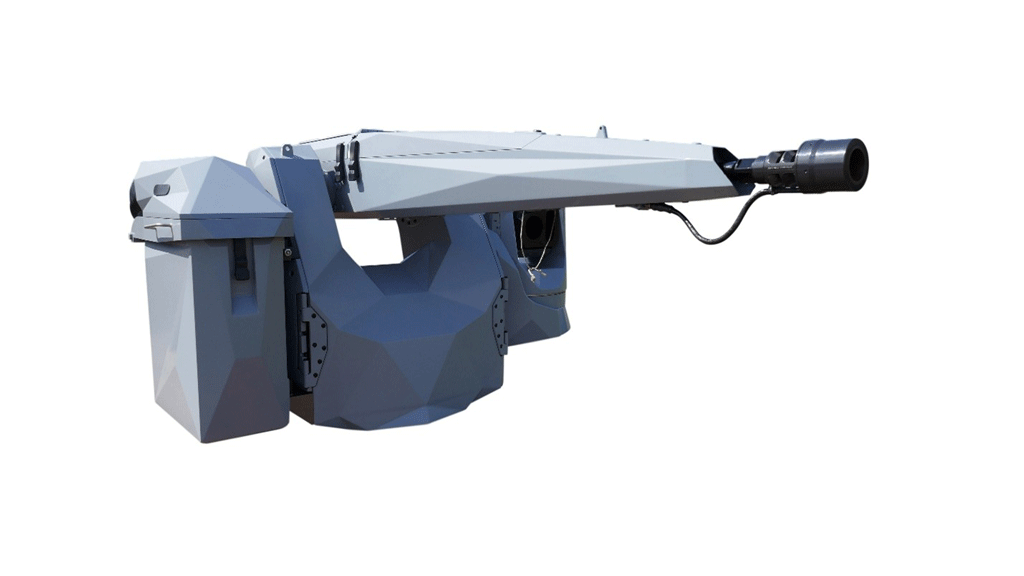
The SeaSnake 30 is a remote-controlled marine assault cannon designed for close-range defense. In addition to the weapon itself, the system includes modern cameras, infrared sensors and a laser rangefinder. It has automatic target detection and the ability to track multiple targets at once. The maximum rate of fire of the gun is 1,100 rounds per minute.
The agreement covers anti-aircraft automatic guns and radar systems for qualified protection against primarily air targets, both manned and unmanned systems, but can also be used against sea and ground targets. The order also includes spare parts, independent training systems for training and integration support.
The total contract value is approximately SEK 670 million.
Procurement for multiple needs
The weapon system will be used on the amphibious battalions’ combat boats. The agreement also includes options for more anti-aircraft automatic guns for other possible platforms, as well as agreements for ammunition, maintenance and service.
The first deliveries are planned for early February 2028, with final delivery in late 2028. The contract was signed in February 2026.
The acquisition is part of the work to build up the amphibious capability of the future within the Amphibious Battalion 2030, a collaborative project between the Swedish Armed Forces, the Swedish Defence Research Agency (FOI) and FMV, and part of the increased self-protection capability of other types of units.
The Armed Forces’ amphibious forces can move quickly between land and water. High-speed combat boats and hovercraft make the unit agile where land meets water. It can be on the coast, in the archipelago, in port areas, on rivers and deltas and in larger lakes.