
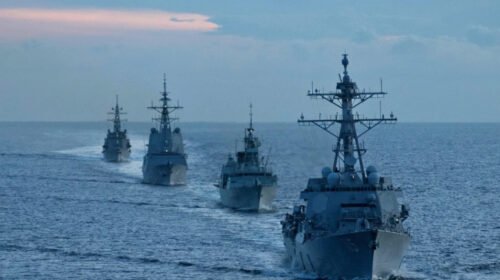
A real-life scenario of escorting a warship was played out during 72 hours of training off the coast of Scotland.
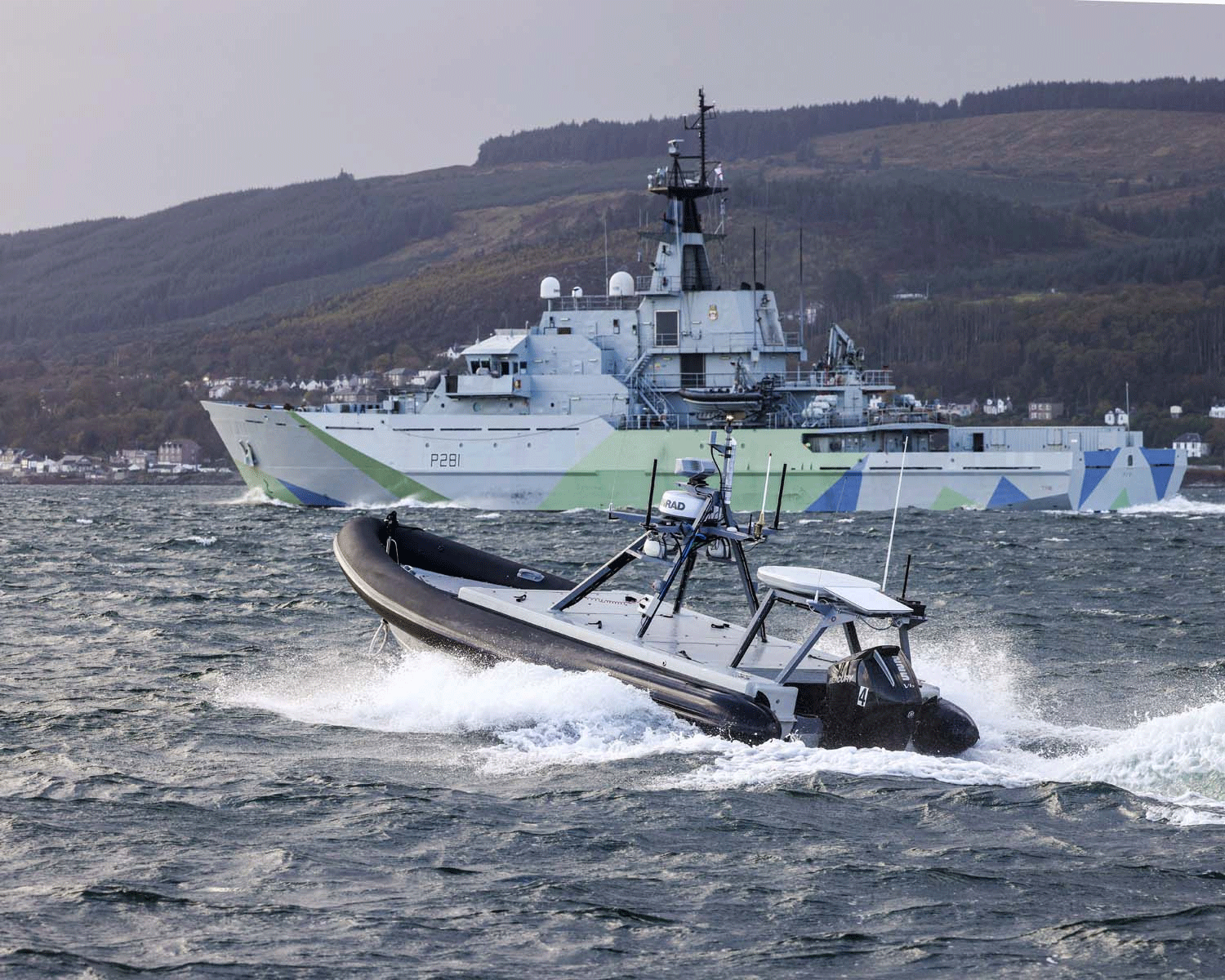
In a milestone for the navy’s Disruptive Capabilities and Technology Office, seven 7.2m autonomous Rattler boats have been trialed over the past few months with their latest test pushing the boats and their controllers to their limits.
While on board XV Patrick Blackett, sitting alongside HMNB Portsmouth, sailors, Royal Marines and Army personnel remotely piloted five of the boats as they sailed in Scotland 500 miles away.
The demonstration saw the vessels work with P2000 HMS Biter of the Coastal Forces Squadron, a Merlin helicopter, HMS Tyne, and HMS Stirling Castle in a proof-of-concept exercise.
With cameras, sensors and other data being fed back to Patrick Blackett, the Rattlers were able to successfully and safely escort Tyne and Stirling Castle who were playing the role of foreign warships.
The demonstration was a culmination of months of trials for DCTO and the Fleet Experimentation Squadron (FXS) while the project of procuring the boats saw the Royal Navy adopt a radical novel approach with industry.
In a matter of weeks, they took the idea of the custom-built, fully crewless vessels and delivered them – with training and first sea trials taking place shortly after.
It is the first time the Royal Navy has procured a fleet of customized uncrewed surface vessels, with the short turnaround time for delivery showing its intent going forward.
Working alongside a consortium of SMEs, military personnel helped design, build, test and develop the vessels to ensure they would be ready to perform in the most demanding conditions – with operators leading and giving direct feedback on research and development to allow the project to move so quickly.
Based on a rigid inflatable boat (RIB) and with autonomy packages and a variety of other systems and services, the boats have been built and iterated to meet Royal Navy specifications.
Unlike previous drones operated by the navy they have been designed to be fully uncrewed. Each vessel can operate individually or as part of a swarm. They can be pre-programmed with mission profiles, navigational routes and can work together as a ‘wolf pack’ on operations. In time they will be able to operate without direct human control.
Equipped with a suite of high quality, military spec sensors, cameras, and modular systems, the boats are adaptable for a range of tasks including surveillance, reconnaissance, and payload delivery.
Their ability to be moved quickly by air, on road and launch from portable slipways opens the door to global operations, even in challenging environments.