
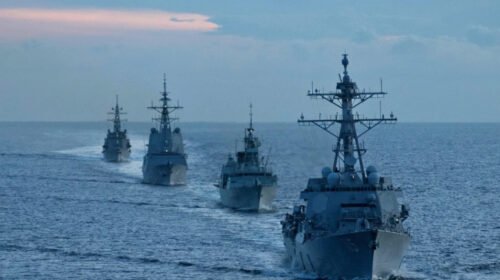
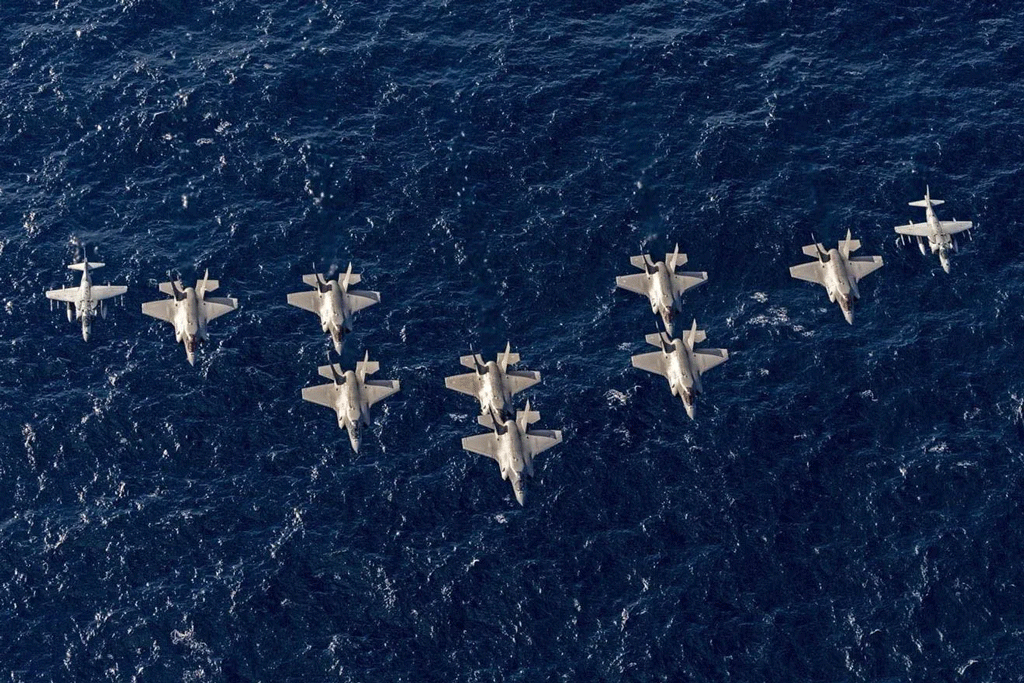
The final major workout of the UK Carrier Strike Group’s 2025 deployment once again underscored the striking power and versatility of the F-35 stealth fighter – as British and Italian jets swapped places.
In the last major set piece exercise of the carrier group’s mission, Italian F-35s called HMS Prince of Wales their home – with RAF and Fleet Air Arm jets doing the same from ITS Cavour.
Falcon Strike in the central Mediterranean was the latest exercise to underscore the ability of nations which fly the F-35B to operate them from each other’s carriers.
Earlier in the Carrier Strike Group’s Highmast deployment, the UK force has worked with US and Japanese F-35Bs.
Jets from both 617 Squadron (The Dambusters) and 809 Naval Air Squadron (The Immortals) joined the Cavour – which is roughly half the size of HMS Prince of Wales and operates up to ten F-35s alongside a dozen AW101 helicopters (the Italian variant of the Merlin).
“It was an awesome opportunity and privilege to be welcomed aboard and operate UK jets from the Cavour,” said Commander Nick Smith, 809’s Commanding Officer.
“The activity is hugely important to prove the true interoperability that is available between F-35 partners who, with shared common procedures and tactics, can effortlessly operate together from one another’s platforms.
“It also sounds a powerful message of NATO’s capability to project fifth-generation combat air power at a time and place of its choosing, whether that be a land base or a range of maritime platforms operated by member states.”
His words were echoed by his counterpart in command of The Dambusters, Lieutenant Colonel Mike Carty RM.
“This is a powerful demonstration of how seamlessly NATO forces can operate as one team, proving that when we work together, we present a capable, credible, and united front against any threat,” he added. “This sends a clear message to any would-be aggressor about our unity and resolve.”
One British F-35B pilot was given the job of ‘paddles’ (aka ‘batman’) on the Cavour – officially Landing Signal Officer – safely guiding returning jets on to the deck of the Italian carrier.
“The language of controlling aircraft in the carrier environment is equal, the procedures and practices are aligned, and an Italian Landing Signal Officer could just as easily control F-35s aboard HMS Prince of Wales as I can control aircraft aboard an Italian carrier,” ‘Paddles’ explained.
“With European militaries shrinking and the ever-increasing threat from our adversaries, the interoperability between NATO allies is more crucial than ever.”
When airborne, the F-35s came under the direction of fighter controllers (nicknamed ‘Freddies’ in the Royal Navy), whose job it is to tactically manage the fifth-generation fighters – directing them on to targets and acting as the vital, seamless link with the carrier group ships.