

Edited for grammar and clarity
A year ago, the Commander Task Force Baltic CTF (Commander Task Force Baltic) officially entered service. On the first anniversary in 2025, the Commander, Rear Admiral Stephan Haisch, spoke about the first year in service, the daily challenges, crucial milestones, and future of his staff.
In terms of security policy, the Baltic Sea is one of the most exciting and at the same time most complex regions in Europe. It is one of the most densely trafficked sea areas in the world and almost all riparian states depend on free and safe sea routes. At the same time, many trade and supply routes run through narrow, shallow waters that would be easy to block in the event of a crisis. In addition, a dense network of power and communication cables as well as pipelines runs along the seabed – the lifelines for Europe’s economy and energy supply. This critical infrastructure is particularly worthy of protection.
Against this background, the Commander Task Force Baltic CTF in Rostock. On behalf of NATO the staff plans, coordinates, and conducts maritime activities in the Baltic Sea and thus ensures safety on and underwater. We spoke with Commander Task Force Baltic, Rear Admiral Stephan Haisch, about the situation in the Baltic Sea, the threat of hybrid attacks and the importance of multinational cooperation for Europe’s security.
Admiral, the Baltic Sea is currently the scene of numerous security tensions. How do you assess the current situation in the maritime environment?
Stephan Haisch
The current situation is tense. Since the sabotage of the Nord Stream pipelines, the issue of protecting critical underwater infrastructure has taken on a new urgency. In the past, we have seen incidents of damaged pipelines and severed communications and power cables, such as C-Lion and Estlink. Each individual case may seem isolated, but the overall picture shows a pattern. Russia is assessing our vigilance and watching very closely to see if and how decisively we react.
The North Atlantic Treaty Organization launched the Baltic Sentry monitoring mission in January 2025. What exactly is the contribution of the CTF and to what extent are you involved in the protection of the Baltic Sea infrastructure?
Stephan Haisch
At its core, it is a reconnaissance and surveillance mission of NATO, which aims to prevent acts of sabotage against critical underwater infrastructure in the Baltic Sea. The aim is to increase the presence of the NATO in selected sea areas, improve the exchange of information between the riparian states and create a comprehensive picture of the situation above and below water.
I lead the naval forces assigned to me and manage their daily operations. This means that we ensure that the sea areas in the Baltic Sea that are important to us are permanently monitored. This includes recognizing behavior of merchant ships that deviate from the norm and sharing this information with our partners. We work closely with the NATO Maritime Command (MARCOM) and with the Maritime Operation Centers of all NATO Baltic Sea navies. Overall, a comprehensive maritime situation picture in the Baltic Sea is created, and our operations center is the central hub for communication, coordination, and data exchange.
You speak of cooperation with Baltic Sea countries. How does this cooperation work in everyday life?
Stephan Haisch
Close cooperation and daily exchange with our allies are the greatest strength of the Commander Task Force Baltic. Our staff consists of people from 13 States side by side. This multinational composition bundles enormous expertise and creates direct communication channels to all participating countries. This enables us to quickly bundle information, data and resources and use them in a targeted manner. Whether it is reconnaissance data from Russian units, satellite images, civilian ship movements, or observations from the air – everything comes together with us, is analyzed, professionally evaluated, and coordinated with the Baltic Sea Navies and the divided.
We see ourselves as a connecting element between the national navies, the naval units at sea and NATO. This close cooperation ensures that we have a very accurate and up-to-date picture of the situation at all times so that we can act quickly and in a coordinated manner if necessary, for example in the event of suspected sabotage of Baltic Sea infrastructure.
Admiral, just over a year ago, your staff Commander Task Force Baltic was officially commissioned. How do you look back on this first year?
Stephan Haisch
I am very satisfied and proud of my women and men. What we have achieved together in just twelve months is impressive. Our goal was ambitious: to be operational within a year. And that is exactly what we have achieved. NATO confirmed our full, unrestricted operational capability at the end of September. For more than 280 days, we have been coordinating the NATO reconnaissance and surveillance mission Baltic Sentry. During Baltic Sentry, we also lead units that have been sent to us by the Allied Maritime Command or by the nations. In total, there were more than 80 different warships from 15 nations. These are impressive figures.
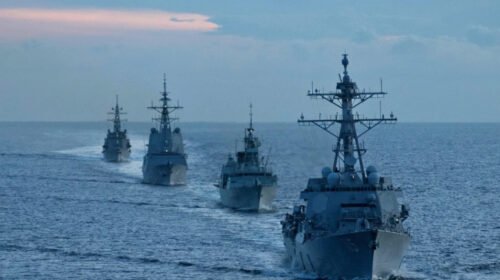
Since our commissioning, we have participated in more than ten exercises and will participate in five more by the end of the year. A special milestone was the United States-Guided large-scale maneuvers Baltic Operations (BALTOPS), in which a multinational task force with around 35 ships was subordinate to me. We moved in similar dimensions in September during the Northern Coasts exercise. Both are demanding maneuvers that show what our staff is capable of. Today, the Commander Task Force Baltic is a firm and dependable partner for NATO and for our allies in the Baltic Sea.
Finally, if you look into the future – where do you see the CTF Task Force Baltic in a year?
Stephan Haisch
I aspire to become even better and faster in all areas. The principle of “ready for the fight tonight” also guides our actions. In concrete terms, this means setting up a Standing Maritime Operational Framework for the Baltic Sea to coordinate our activities even better and join forces. We must practice what we must do in a crisis or in war. The term “train as you fight” is not an empty phrase, it is a basic prerequisite for successful action. And I want us to use even more sources for our situation picture and become even more accurate with the inclusion of artificial intelligence. The CTF Baltic has further consolidated itself and is contributing to the development of the Baltic Sea on behalf of NATO responsibility for all maritime activities in the Baltic Sea region. The Baltic Sea is our lifeline and therefore we must be able to respond appropriately and quickly to any possible threat.