
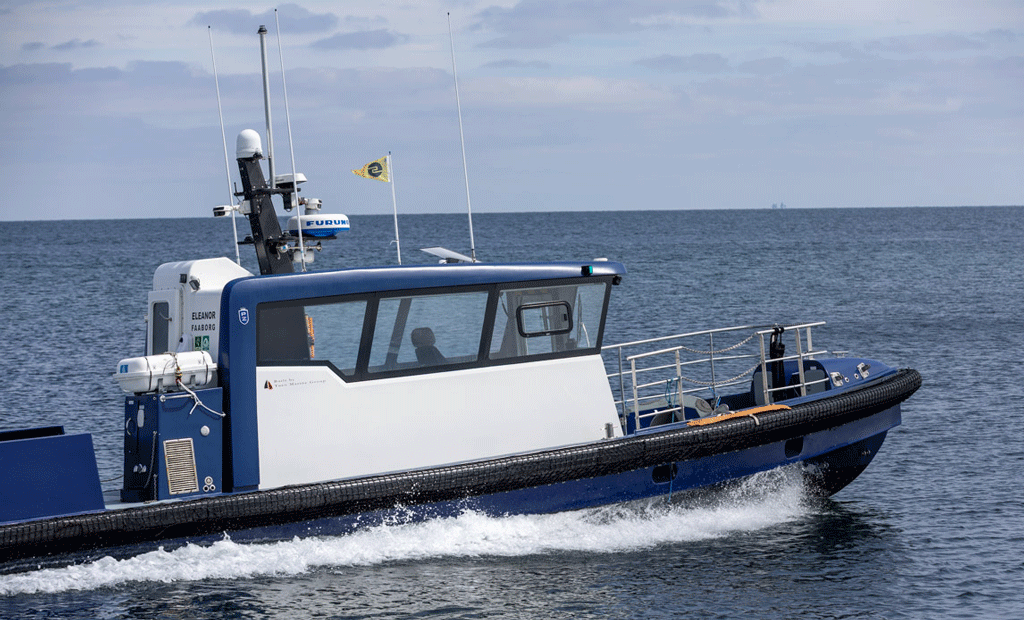
The blue motorboat at the quay looks like an ordinary motorboat. There is both throttle and rudder and room for several people in the cabin.
But when Eleanor, as the blue boat is called, has set sail and sets course for the waters at the Navy’s Tactics and Weapons School at Gniben at the tip of Sjællands Odde, there is not a human at the helm. Eleanor is controlled from a computer on land and via built-in software and hardware that turns the blue motorboat into a maritime drone. Or more technically correct: a maritime unmanned system.
Eleanor’s voyage at Gniben this summer day is an offshoot of the plan for the development of the Danish navy under the 2024-2033 defense agreement. And more precisely, a project that will look at opportunities and potential for the acquisition and use of maritime drones to support the Navy’s task solving in the future.
The Armed Forces began testing maritime drones as early as 2025.
“There is a great focus throughout the Armed Forces on how we introduce and use maritime drones. Considering what has happened in Ukraine since 2022 and the development in the area in general, we are obliged to learn more about the area. It is a high priority that we generate the necessary knowledge as soon as possible so that we can implement maritime drones as a capability in the Navy,” says Commander Klaus Thing Rasmussen, project manager for the Autonomous Units project.
The work to introduce maritime drones is proceeding in several tracks. One of them is to investigate the maturity of the technology.
“We are in the process of a number of demonstrations where we have asked different companies to show their solutions in maritime drones. It is not an actual test where we systematically test and compare the different solutions, but the process will give us a sense of where the industry is and what solutions are available,” explains Klaus Thing Rasmussen.
Find and follow
Out on the water, after an initial outage on the internet connection, Eleanor finds the buoy that is the first target of the day, and later the boats and its software and sensors also manage to follow and keep a certain distance from a jet ski that is the “target”.
The demonstration does not contain elements where Eleanor, or the other drones demonstrated for the project, will deliver weapon effect.
“Right now, we are running some relatively soft scenarios in monitoring and intelligence gathering, where we look at what can be done with vessels of the size, we have here and with the sensor package that is on. We are starting here because regardless of what effects we want to achieve with autonomous systems, you need a sensor package that can deliver data,” explains Jonathan, who is electronics engineer and special consultant at the Navy’s Center for Maritime Unmanned Systems (CEMUS). CEMUS is, like the Autonomous Devices project, a new center that will support the development of autonomous devices.
“For some, the tasks are easy. For others, it is difficult exercise, and it helps us understand what the industry can offer and what works and what does not work,” adds Klaus Thing Rasmussen.
Part of the exercise is to investigate what happens if something unforeseen should happen. According to Klaus Thing Rasmussen, small technical challenges often arise with the drones, such as a cable jumping out of a socket or the screws for a camera having to be tightened.
“On a manned ship, it could be done in 30 seconds. But you can’t do that when the unmanned system is far from land. This is one of the many experiences we have gained that we need to keep an eye on,” says Klaus Thing Rasmussen.
Report 2027
After the current demonstration phase, the project will continue with a long-term test process with several suppliers. For this process, the project Autonomous Units has defined four use scenarios that cover different Danish waters (where, for example, geography, tasks and duration entail a need for different solutions) and different types of the tasks that the Navy solves today or must be able to solve in a conflict. It is everything from showing presence and conducting maritime surveillance to the use of maritime drones as platforms for weapons or a weapon.
Demonstrations, tests and tests will result in the project submitting a report in 2027 with recommendations in relation to introducing autonomous capabilities in the Navy, says Klaus Thing Rasmussen:
“Here we have to think all the way around the drone concept. Which sensor types are suitable for the different tasks, what is needed in terms of education, what is needed in the establishment area, how should the data infrastructure be set up and what doctrinal basis is needed and other relevant aspects.”