
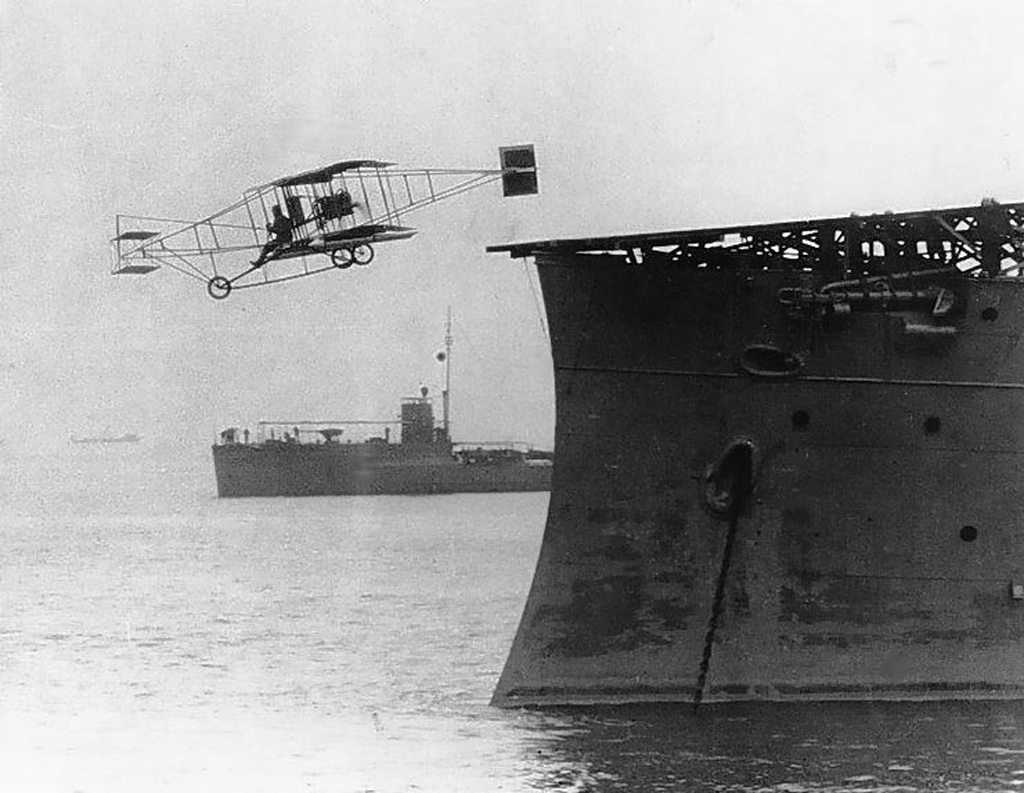
On November 14, 1910, Eugene Burton Ely chugged his Curtiss Model D “Pusher” off the bow of the light cruiser USS Birmingham and into history.
Ely earned an engineering degree in 1904 from Iowa State University and worked as an automobile salesman, mechanic, and racing driver before he taught himself to fly in 1910 and never looked back. He became well-known for stunts that pushed the limits of early aviation as a pilot with the touring Curtiss Exhibition Team. At this same time, Captain Washington Chambers was tapped by the Navy to explore the potential between aviation and naval warfare. Chambers met Glenn Curtiss and Eugene Ely and the scheme to launch from and land back on board the deck of a ship was hatched.
Ely’s take-off in his Curtiss Pusher from an 80-foot wooden platform on the bow of the USS Birmingham was less than ideal. The aircraft rolled off the edge of the platform, settled, and then briefly skipped off the water, damaging the propeller. But Ely managed to stay airborne and landed just over two miles away on Willoughby Spit.
The derring-do was deemed a successful proof-of-concept, and was followed by Curtiss, Ely, and Chamber teaming up two months later in January 1911 in San Francisco, where Ely took off from shore and safely landed his plan on the deck of the armored cruiser USS Pennsylvania.