
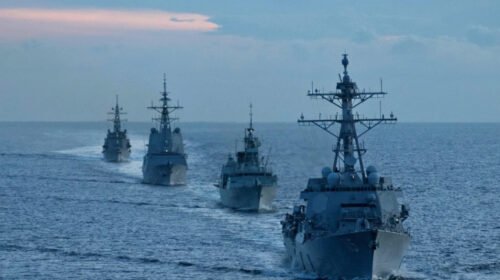
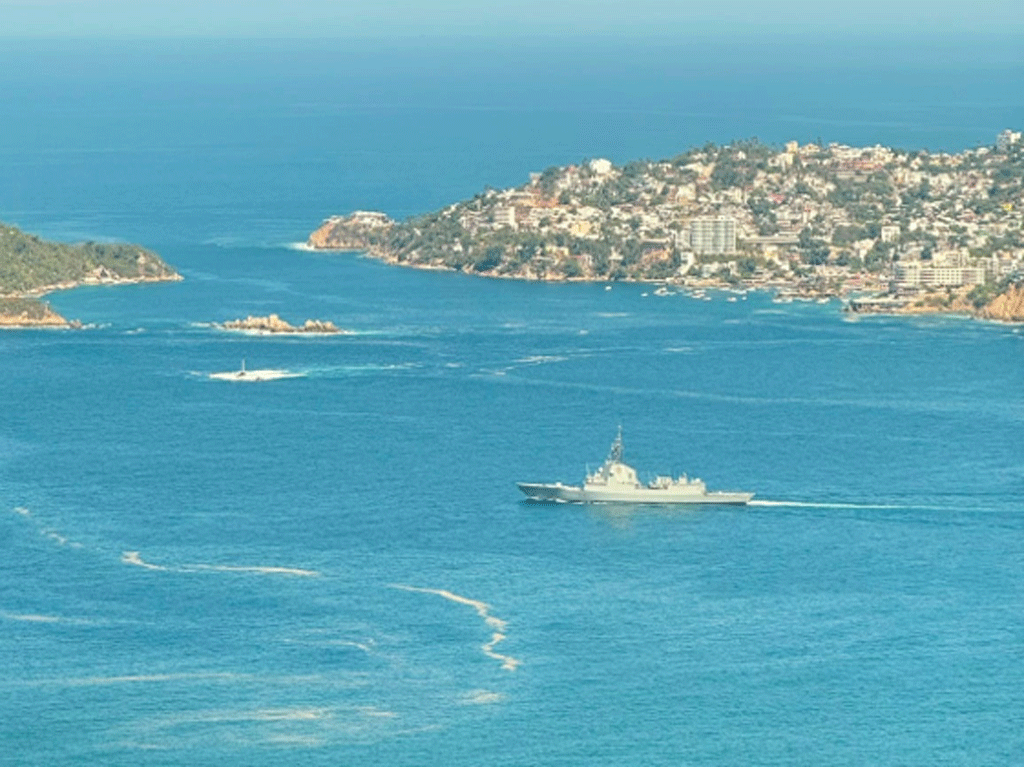
The frigate ‘Álvaro de Bazán’ (F-101) arrived at its home port in Ferrol (NW Spain) on the afternoon of Tuesday, October 20. This docking at pier number 3 marks the successful conclusion of a demanding international deployment of more than five months, which began on May 12 with its departure from Galician waters.
During these 161 days of operations, the crew completed a voyage of 30,000 nautical miles, a distance equivalent to 1.3 times around the world, operating in high-intensity scenarios in the Atlantic and Pacific Oceans. The mission has highlighted Armada’s expeditionary capabilities and its commitment to global maritime security, achieving full integration into multinational task groups beyond the NATO domain.
A Strategic Enclave for the Defense and Alliance Networks
For the Armada, this deployment has meant a deep strategic significance that extends well beyond the mere training. Spain’s active presence in the Indo-Pacific region is essential for strengthening our own national defense network and for consolidating ties with our international allies. Operating in these distant theaters allows Spain to become firmly integrated into the global security architecture alongside the world’s most advanced maritime powers. This demonstrates that the capability to protect our supply lines and defend our national interests is not confined to our immediate sovereign waters; rather, it requires a credible and coordinated presence along the world’s major logistic and commercial sealines of communication.
An Intensive, High-level Exercise Program
In the waters of Hawaii, the vessel represented Spain for the first time in RIMPAC 2026—the world’s largest international maritime exercise. During these maneuvers, it operated alongside approximately thirty nations with thirty-five surface ships, five submarines, and more than two hundred aircraft. In the at-sea stage of the exercise, the frigate demonstrated the effectiveness of its weapon systems by conducting a live-firing of a Harpoon missile as part of a controlled sinking exercise (SINKEX), coordinated with the Japanese destroyer JS ‘Kongo.’
Subsequently, the ‘Álvaro de Bazán’ operated as flagship for the biennial ballistic missile defense exercise, PACIFIC DRAGON 26. To fulfill this role, it embarked the Commander and Staff of the U.S. Navy’s Destroyer Squadron 31 (COMDESRON-31) on board. In this technologically complex environment, the frigate’s AEGIS combat system demonstrated an outstanding capability to coordinate the detection and tracking of ballistic threats.
The deployment continued then in South America with participation in the GALAPEX exercise (Ecuador) and, subsequently, in UNITAS LXVII-2026 (Peru)—the world’s longest-running naval exercise. During the latter, organized by the Peruvian Navy, the ‘Álvaro de Bazán’ once again distinguished itself by successfully employing its 5-inch main gun in a SINKEX (sinking exercise) against the decommissioned amphibious vessel BAP ‘Eten’. The Spanish vessel also conducted a series of naval gunfire support missions in the Bay of Salinas. Before beginning the return transit to Spain, the crew made a logistic port call in Cartagena de Indias (Colombia).
Beyond its noteworthy operational activities, the frigate also fulfilled significant diplomatic and official duties in each of the ports it visited. These port calls not only strengthened international cooperation but also reaffirmed one of the vessel’s most vital missions: projecting Spain’s image abroad and consolidating its presence within the global naval sphere.