
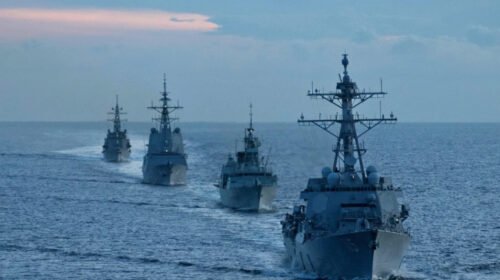
With the arrival of the destroyers ARA “La Argentina” (DELA) and ARA “Sarandí” (DESI), the corvette ARA “Espora” (CBES) and the logistics ARA “Patagonia” (LGPA), a new sea stage was concluded in which integrated naval operations were carried out together with the icebreaker ARA “Almirante Irizar” (RHAI) and the ocean patrol vessel ARA “Almirante Storni” (POST).
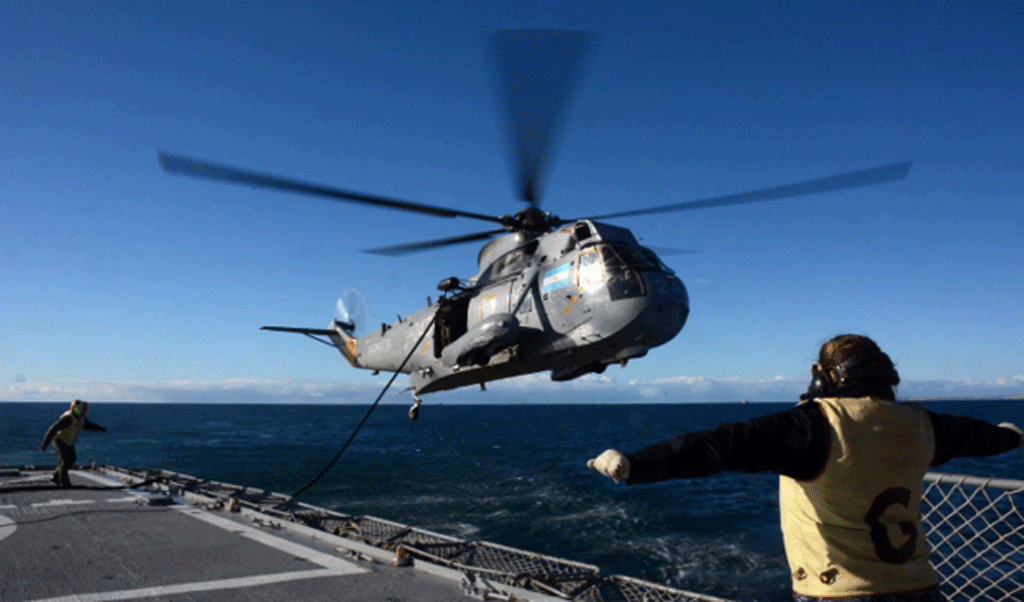
Fennec and Sea King aircraft, from the First and Second Naval Air Helicopter Squadron, P-3C Orion aircraft from the Naval Air Exploration Squadron, Beechcraft B-200 from the Naval Air Surveillance Squadron and personnel from the Tactical Divers and Amphibious Commandos Groups of the Special Naval Operations Forces Command also participated. 3rd and 4th year Cadets of the Naval Military Academy were also embarked in different units.
The operation was in charge of the Commander of the Sea Fleet, Rear Admiral Pablo Basso, who was accompanied by his Chief of Operations, Captain Miguel Caviglia, both embarked on the destroyer ARA “Sarandí”. Also participating were the Commander of Naval Transport and Instruction, Captain Hugo Damario, embarked on the RHAI, the Commander of the Maritime Patrol Division, Captain Roberto Lovera, on board the POST; the Naval, Amphibious and Logistics Commander, Captain Fernando González, on the LGPA, and the Commander of the Corvette Division, Captain Christian Corona, on board the CBES.
After the open days in the city of Puerto Madryn, as part of the celebrations for Flag Day, the RHAI and the DESI, with naval air units on board, and the POST set sail for the general north. At the same time, from Puerto Belgrano, the DELA, the CBES and the LGPA cast off their moorings heading south, to carry out a tactical meeting on both sides.
Training
During the start of operations, after leaving the Golfo Nuevo, the units carried out anti-submarine warfare exercises together with the P-3C Orion aircraft, carrying out area scouting tasks, tactics with sonobuoys and magnetic anomaly detectors (MAD), where the launch of a drill torpedo from a Sea King helicopter was also carried out. to then move on to anti-surface warfare configuration.
In addition to the usual individual training in abandonment, firefighting and damage control roles, aircraft launch and recovery and combat roles were carried out, to then move on to exploration, fishing and take-off (paid) and cross deck exercises, with Fennec helicopters from the First Aeronaval Helicopter Squadron, and in-flight refueling with Sea King.
The next morning he found the Task Force sailing in formation. Air defense training was carried out with B-200 aircraft, in which it was sought to protect the RHAI and the LGPA, developing exercises of detection, tracking, designation of trans horizon targets, and surface attacks together.
During the afternoon, Special Forces personnel were deployed from the “Storni” to the “Irizar” to carry out maritime interdiction exercises, a methodology used during the maritime traffic control and surveillance patrols that the Navy carries out in Argentine jurisdictional waters. There they made incursions by sea and helicopter with fast rope practices.
Consecutively, an effective refueling maneuver (RAS) was carried out between the “Patagonia” and the destroyers, which culminated in communications exercises, launching chaff -decoys- and flares, electronic warfare, evolutions and tactical maneuvers.
Prior to entering Puerto Belgrano, the destroyer ARA “La Argentina” carried out effective firing runs with 40 and 127 mm cannons to fixed targets on land, while the icebreaker moved to the area of El Rincón, from where it carried out an amphibious and heliborne landing exercise together with personnel of the Amphibious Brigade of the Marine Infantry.
Regarding this new sea stage, whose objective was integrated naval training, the Chief of Operations of the Sea Fleet, Captain Miguel Ricardo Caviglia, said: “This sea stage has allowed the participating Units to significantly increase the level of training and interaction, achieving the objectives set by the Sea Fleet Command in Integrated Naval Operations.”
With each of its naval operations, the Sea Fleet deepens the readiness of the units and the training of its personnel, with the focus on the modernization of its surface units, and with a view to future missions in the Argentine Sea and the fulfillment of international commitments such as the Fraterno exercises, together with the Brazilian Navy. and the multinational Unitas, which will take place in Peru, led by the United States Navy.