
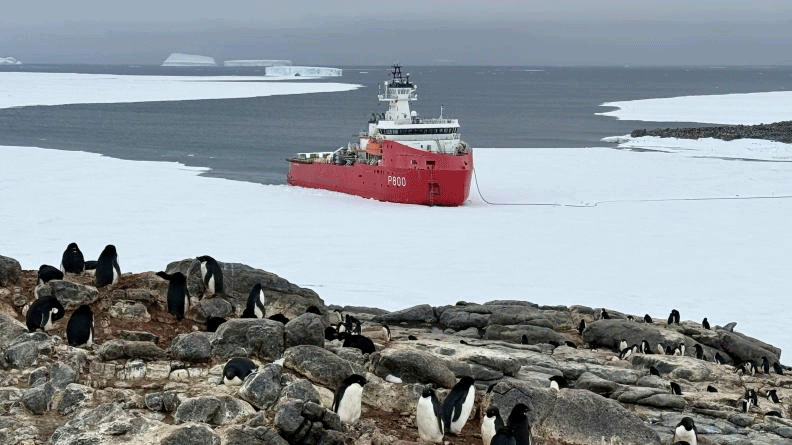
After an initial rotation to Dumont d’Urville Station (DDU) which lasted more than three weeks, patrol vessel L’Astrolabe set sail south again on December 12, 2025, as part of her Antarctic Logistics Support Mission (MSLA).
During its crossing, the ship made a stop off the Australian coast of Macquarie Island to disembark Australian scientists and equipment, as part of the existing cooperation between the Australian Antarctic Division (AAD) and the French polar institute (IPEV).
This year, L’Astrolabe encountered a significant concentration of ice, a rather rare occurrence in the middle of the austral summer. Eight days of navigation through the ice were required to approach the continent and reach the polynya (open water area) in front of the Dumont d’Urville (DDU) station.
Off the coast of DDU, L’Astrolabe had to perform “ramming,” a method of pounding the ice floe, to get as close as possible to the station. In Lion Cove, the unloading area for the French polar station, L’Astrolabe was able to begin logistical operations via its onboard helicopter and deliver 340 m³ of fuel. This cold-resistant fuel, called SAB, is a key element of polar logistics, ensuring the operation of the station’s electrical generators.
Owned by the French Southern and Antarctic Lands (TAAF) and operated and maintained by the French Navy, L’Astrolabe is an icebreaker vessel born from a partnership between the TAAF, the French Navy, and the French Polar Institute (IPEV). The vessel relies on two crews of around twenty sailors who operate it alternately to conduct logistical support missions in Antarctica and sovereignty missions in the maritime zone of the southern Indian Ocean, particularly in the French Southern and Antarctic Lands.