

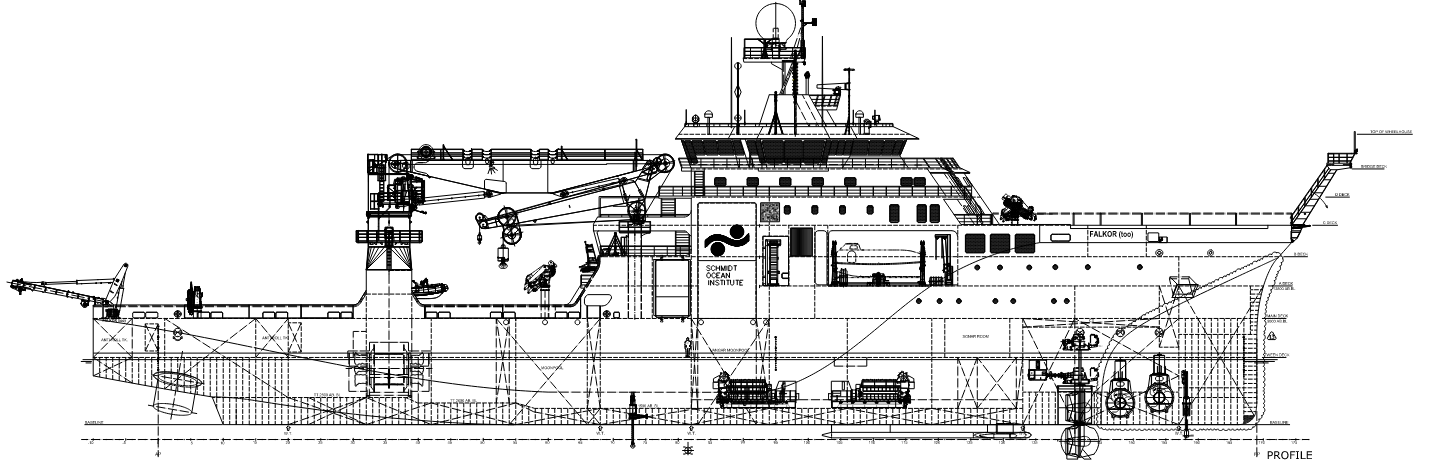
Schmidt Ocean Institute announces it has mapped 2 million square kilometers of seafloor — about the size of Greenland — and this year, has made two significant changes to advance the seafloor mapping capabilities of R/V Falkor (too): it radically changed the shape of the ship’s bow and added the gold standard of Autonomous Underwater Vehicles (AUV) to its technology suite.
“There has always been a commitment from our organization to continuously improve what we can provide to the scientific community,” said Schmidt Ocean Institute’s Senior Director of Maritime Infrastructure, Eric King. “We moved quickly to make these latest changes in response to lessons learned in our first two years of expeditions aboard R/V Falkor (too), and we have never been better positioned to provide the best quality data to scientists around the world.”
Over a two-month dry dock period (28 April – 28 June) in Talcahuano, Chile, the team reconstructed the bow of R/V Falkor (too), transforming it from a bulbous bow more common on offshore commercial vessels into a streamlined, V-shaped bow optimized for science missions. The new bow significantly improves the precision and reliability of the ship’s sonar systems in capturing high-quality mapping data, even in challenging weather conditions. It can now capture high-resolution data in 6-11 knots (~7-13 mph) and in swells exceeding three meters.
R/V Falkor (too)’s new bow helps to eliminate bubbles from interfering with the ship’s sonars and sensors, which proved challenging with the previous bulbous bow— an aspect of the original MV Polar Queen vessel design that assisted in faster transits across the ocean. Seafloor maps are created using multibeam sonar technology, which sends sound from the vessel to the seafloor. Scientists, especially hydrographers, use the time it takes for the sound to travel between the ship and the seafloor to calculate the depth, creating a bathymetric map and revealing seafloor features like underwater mountains and canyons.
“Reconstructing the bow was a massive undertaking and a clear demonstration of Schmidt Ocean Institute’s commitment to advancing oceanography. The shipyard period required dedication and hard work from teams across the entire organisation, including our fantastic crew,” said Captain Peter Reynolds of R/V Falkor (too). “The result is the ability to collect higher-quality sonar data at greater speeds. Combined with our new AUV, this significantly enhances our scientific capability during our expeditions.”