
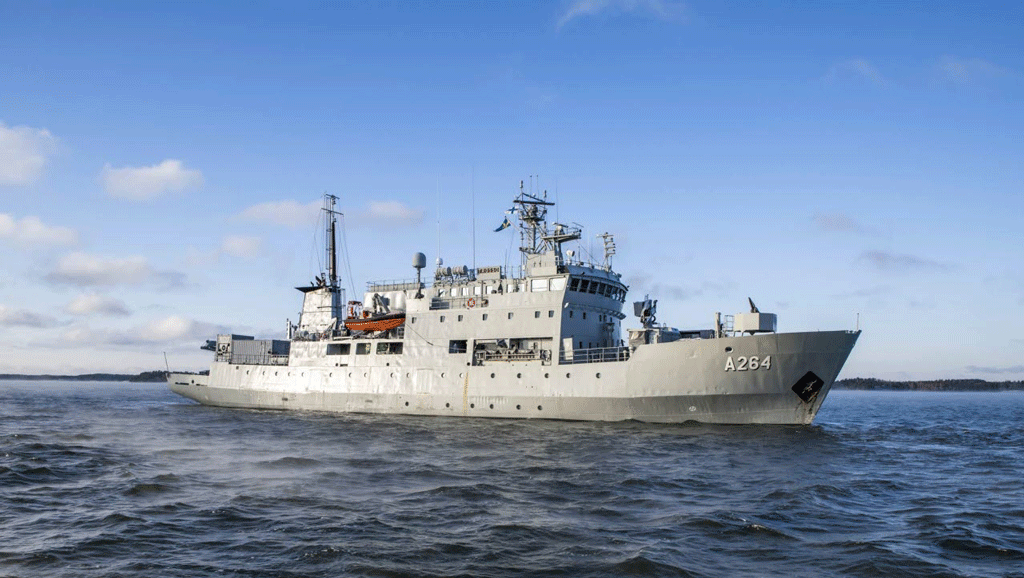
H(SW)MS Trossö was once a Soviet ship named Arnold Veimer. The Swedish Navy bought it from Estonia in 1996 and HMS Trossö was then given its current name. Today, she is an important part of the Navy’s work with maritime surveillance on the Baltic Sea.
From Soviet research to Swedish maritime surveillance
Trossö was once a Soviet ship named Arnold Veimer. The Swedish Navy bought it from Estonia in 1996 and HMS Trossö was then given its current name. Today, she is an important part of the Navy’s work with maritime surveillance on the Baltic Sea.
On board, the crew acts as “eyes and ears” at sea, following everything that moves along our coasts. It is about detecting deviations, keeping an eye on the shadow fleet and making sure that no one is in Swedish waters without permission.
A new security situation in the Baltic Sea
After Russia’s invasion of Ukraine, interest in what is happening in the Baltic Sea has increased significantly.
“We see how important the so-called shadow fleet is for Russia. The oil exports that go on these ships finance the Russian war, says Johan, the ship’s commander on board.
The Russian shadow fleet consists of ships that trade in Russian oil in violation of Western sanctions. These vessels are often unregistered, lack insurance and try to avoid detection.
“It’s about knowing who they are and making sure they can’t circumvent the sanctions by sneaking into Western ports,” says Johan.
Maritime surveillance takes place in collaboration between ships such as HMS Trossö and a network of fixed radar stations along the coast. By following ship movements, the Navy can detect anomalies, suspected oil spills, or identify ships that are trying to conceal their identity.
“We simply want to know what is happening along our coasts, and make sure that no one is in Swedish waters without permission,” Johan explains.
From Soviet to Swedish
“Trossö has a completely unique history in the Swedish Navy,” says Johan.
Unlike most Swedish ships, Trossö is not domestically built, but was constructed in Finland during the 1980s – on behalf of the Soviet Union. The ship was one of several built for polar research in the Arctic.
After the fall of the Soviet Union, Trossö remained in Estonia, stationed in Paldiski. According to a popular rumor, it was the poor maintenance that caused the ship’s engines not to start on the morning of the other Soviet ships’ return to Russia. Thus, it remained in the possession of the Estonian state.
In the mid-1990s, when Sweden needed a temporary support vessel for the anti-submarine force, the ship was bought by Estonia. After modifications, it was put into service as a support ship in the Swedish Navy. A “temporary solution” that turned out to be anything but short-lived.
“The temporary was quite long-lasting. The ship has been rebuilt several times and is still in active Swedish service,” says Johan.
An important cog in the Navy’s logistics
Today, Trossö is used as a support ship within the 2nd Marine Base Battalion, under the Stockholm Amphibious Regiment. Its task is to ensure that other ships get what they need at sea – diesel, ammunition, provisions and spare parts. On board there are also medical resources that allow Trossö to function as a medical vessel during major exercises or operations.
But it’s not just the logistics that are important. The ship also plays a significant role in Sweden’s maritime surveillance – a job that involves keeping track of everything that moves along our long coasts and out on the Baltic Sea.
For Molly, who works as a signal sailor on board Trossö, everyday life at sea is about both responsibility and community.
“I work as a signal and deck sailor and one of my main tasks is lookout duty. This means that I stand on the bridge and keep an optical lookout 360 degrees around the ship. We report everything we see – ships, aircraft, movements – to support the manoeuvring officer,” she explains.
Voices from Trossö
Working closely together for long periods at sea creates strong bonds.
“You live so close to each other, so it’s like a little family. Many find their best friends for life in the Armed Forces. We don’t just work together, we should be able to work together in war as well, so the relationships will be very special,” says Molly.
For her, it has never been difficult to be away from her family.
“I’m probably the kind of person who doesn’t get homesick. When I’m at sea, the crew is my family.
Maritime surveillance is combined with exercises on board.
“We practice a lot on protective alarms, such as fire or water ingress. Everyone should know exactly what to do if something should happen. The more we practice, the better we get when it happens in real life,” says Molly.
What attracted her to the profession was the desire to be challenged and developed.
“I see this as any other job – the most important thing is that I enjoy my colleagues and my tasks. Here you are constantly faced with new challenges and learn to solve problems in new ways. You really develop as a person.
History and future
From its time as a Soviet research vessel to its role as a Swedish support unit and part of the country’s security structure, HMS Trossö has carried a history as multifaceted as the Baltic Sea itself.
For the crew, it is not just a ship – it is a home, a workplace and a symbol of how history and the future meet on the high seas.
“The ship has changed a lot – but its history lives on,” says Johan.