
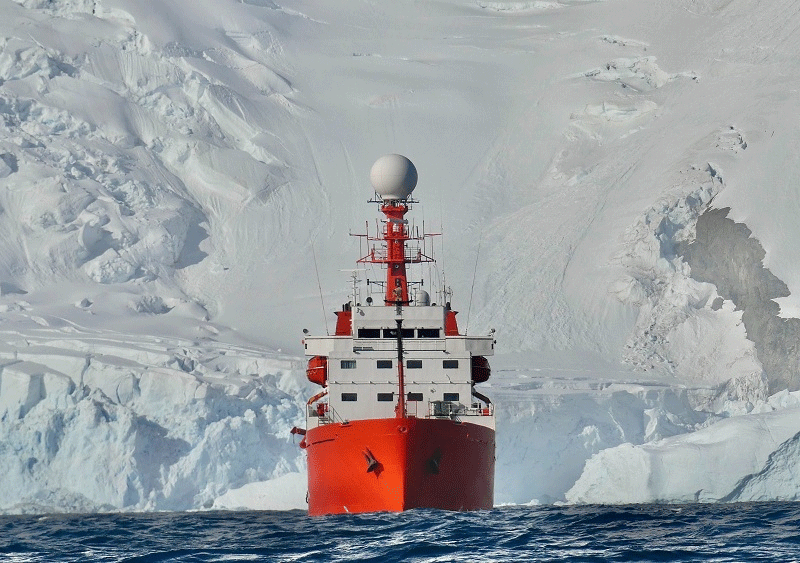
The Oceanographic Research ship ‘Hespérides’ kicks off its 30th Antarctic Campaign.
The mission of the Oceanographic Research ship ‘Hespérides’ is part of the Spanish 2025-26 Antarctic Campaign, setting up a cooperation model between different public and private institutions at the service of R&D+I within the framework of the State Plan for Scientific and Technical Research and Innovation.
With a scheduled period of 164 days and the participation of approximately 200 people, the ‘Hespérides’ will provide intensive logistical support to the Spanish Antarctic Bases ‘Gabriel de Castilla’ and ‘Juan Carlos I’, as well as support the development of scientific projects of high strategic and technological value. The Spanish Polar Committee is responsible for coordinating the activities conducted by the different organizations during the Antarctic Campaigns.
These projects will cover diverse areas such as the study of solar activity, geodesy, underwater morphology, and climate change. Among them, the ‘GALILEO’ project stands out. Developed by the Hydrographic Institute of the Armada (IHM in its Spanish initials), it intends to support the validation of the Public Regulated Service (PRS) of the European positioning system ‘Galileo’ in high-latitude areas of the Southern Hemisphere.
To accomplish the studies, the ship has 11 laboratories dedicated to several types of research, comprising more than 350 square meters of permanent space for on board science. In addition, the fixed scientific equipment includes various sounders for biomass quantification and hydrographic bathymetry, a seismic profiler, a marine gravimeter, and a CTD (Conductivity-Temperature-Deep) instrument, which can collect water samples at different depths of up to 6,000 meters while performing other measurements.
Scientific Contribution of the Armada
Throughout its history, the Armada has played a decisive role in the development of scientific knowledge. Key examples of its contribution include the Malaspina Scientific Expedition and the voyages of Jorge Juan and Antonio de Ulloa. This institution has also been a pioneer in scientific fields, such as the creation of the first Astronomical Observatory in 1753, the first geomagnetic station in 1875, and the first seismic station in 1898. Today, this work continues, not only with the contributions of the research ship ‘Hespérides’ but also with organizations such as the Hydrographic Institute of the Armada (IHM) and the Royal Naval Observatory.
The mission of the IHM (Hydrographic Institute) is to ensure navigational safety by obtaining and disseminating information about the sea and its coastline, thereby contributing to the development of nautical science. It is the sole guarantor of the updating of national nautical charts and provides public information to the scientific and educational communities, as well as public administrations, for the development of their research projects, facilitating decision-making in the maritime domain.
For its part, the Royal Observatory conducts theoretical studies and calculations related to different fields such as astronomy, geodesy, geophysics, and the maintenance of physical time, and is responsible for calculating and disseminating the official time in Spain.