
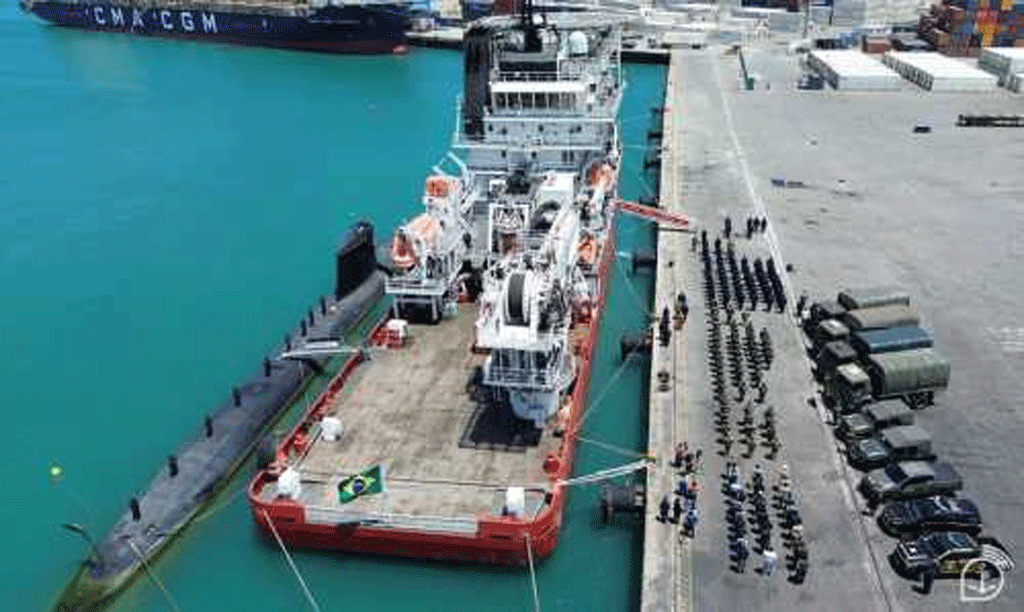
With a briefing at the Captaincy of the Ports of Ceará and the activation of the Task Force “Terra da Luz”, the 2nd Submarine Cable Protection Exercise, coordinated by the Brazilian Navy (MB), began on Monday (10) in Fortaleza (CE). In this phase of the training, the Navy’s response capabilities are improved to guarantee the security of critical infrastructures. The meeting was attended by representatives of the MB, public security agencies, private companies and the press.
Currently, Brazil has 17 submarine cable systems that interconnect the country’s states and the rest of the world. This infrastructure is responsible for almost all data transmission, enabling the interconnection of telecommunications and internet systems. Government services, commercial and financial transactions are carried out through it, all potential targets of actions that compromise national security.
This land-based phase of the exercise includes protecting other areas of interest, such as the beach manhole —an installation on the beach that houses the junction between submarine and terrestrial cables—and the cable landing station, the location where data is transferred and then distributed.
“Fortaleza is the second largest submarine cable hub in the world, so basically more than 90% of Brazil’s data communications with North America, Central America, Africa, and Europe pass through here. In these submarine cables, [whether it’s] a misfortune at sea or sabotage, it’s very important (…) to be ready to respond,” explains the Commander of the 3rd Naval District, Vice-Admiral Jorge José de Moraes Rulff, the authority in charge of this operation.
A total of 385 military personnel and 23 assets were mobilized, including the submarine rescue ship “Guillobel” (K120), the submarine “Humaitá” (S41), and the SH-16 “Seahawk” helicopter, as well as the P-95 patrol aircraft from the Brazilian Air Force (FAB). Also participating in the exercise, as part of this effort, are 44 technicians from different submarine cable companies.
The operation involves the participation of several public bodies, such as the Institutional Security Office of the Presidency of the Republic (GSI), the Brazilian Intelligence Agency (ABIN), the Federal Police, the Ceará Port Authority (CDC), the Civil Police of the State of Ceará, the Secretariat of Public Security and Social Defense (SSPDS), the Military Police of the State of Ceará (PM/CE), the Municipal Transit and Citizenship Authority (AMC), Petróleo Brasileiro SA (Petrobras), the Ministries of Defense and Communications, and the National Telecommunications Agency (ANATEL). Private companies in the telecommunications and technology sector are also participating in the exercise, such as Telxius, Azion, Claro, Sparkle, V.Tal-Globenet, Seaborn, Angola Cables, Blue Marine, Emgepron, Backbone, BRS Robótica, Tidewise, and Tecto.