
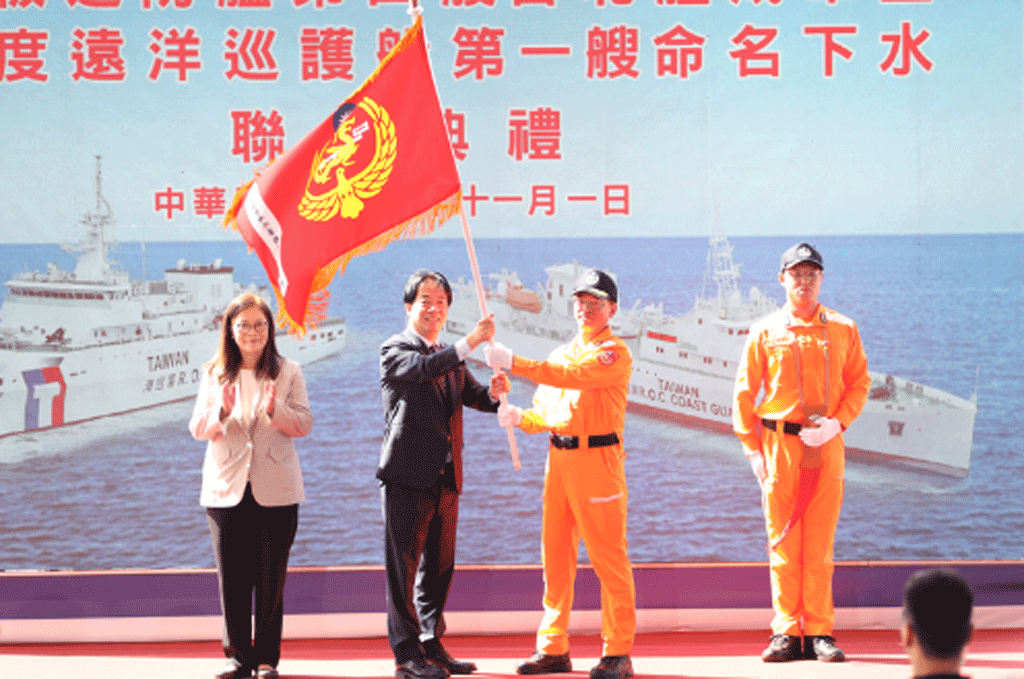
The Coast Guard Administration Fleet Branch of the Ocean Affairs Council held a joint ceremony today (1st) at Taiwan International Shipbuilding Corporation to mark the commissioning of the fourth 4,000-ton class frigate, the Taipei, and the naming and launching of the first high-latitude ocean-going patrol vessel. The ceremony was presided over by the President and was attended by Kaohsiung Mayor Chen Chi-mai, Chairman of the Council of Indigenous Peoples Tseng Chih-yung, Chairman of CSBC Corporation Chen Cheng-hung, Committee Members Lee Po-yi, Chiu Yi-ying, Hsu Chih-chieh, and Lai Jui-lung, Navy Commander Tang Hua, Deputy Minister of National Defense Huang Yu-min, Deputy Minister of Economic Affairs Lai Chien-hsin, Ms. Wan Shu-chuan, promoter of the Siraya name rectification movement, industry representatives, and local dignitaries to witness the phased achievements of Taiwan’s “indigenous shipbuilding” policy.
The Taipei-class frigate is the last 4,000-ton class frigate in the “Forward-Looking Development Plan for Coast Guard Vessels”. It is approximately 126.3 meters long and 16.5 meters wide, with a range of 10,000 nautical miles and the ability to withstand gale-force winds of up to level 10. It is equipped with three sets of high-pressure water cannons with a range of 120 meters, which are important equipment for conducting maritime expulsion missions. It is also equipped with a 20mm remote-controlled machine gun to assist in law enforcement, as well as the Zhenhai rocket system to support peacetime and wartime conversion. The ship is also equipped with sophisticated professional medical equipment, with a medical cabin of the standard of a field hospital, which can provide remote medical video in case of emergency and provide timely medical treatment to the wounded.
The newly named and launched “SIRAYA” is the first high-latitude ocean-going patrol vessel under the “Development Plan for Coast Guard Ocean-going Patrol Vessels”. It has a gross tonnage of approximately 5,000 and a range of 15,000 nautical miles (approximately 27,780 kilometers). Equipped with equipment adapted to high-latitude, low-temperature navigation, it can enforce the law within a 55-degree latitude range north and south. In the event of large-scale evacuations or maritime rescues, it can adjust its space configuration, enhancing personnel accommodation space. Furthermore, the Siraya adopts an “axe bow” design, using wave-cutting instead of wave-climbing, significantly reducing the slamming effect of the traditional bow lifting and violently hitting the sea surface, making the hull more stable in wind and waves.
The Taipei-class destroyer commenced its first mission on September 11, sailing 1,300 nautical miles to Palau for a 14-day training voyage focused on goodwill. During the voyage, various maritime training exercises were conducted, including navigation operations, emergency response, search and rescue, and damage control. These exercises aimed to evaluate the new ship’s performance and system integration, and to allow the crew and equipment to fully integrate. On the return voyage, the ship encountered Typhoon Hato, requiring maneuvering at sea to further demonstrate its seaworthiness. This mission confirmed that the ship and its equipment met performance standards, and that the crew’s operation and duty performance met mission requirements. The commissioning ceremony was held today (1), officially commencing its service with the Coast Guard. President Lai stated that witnessing the commissioning of the fourth Chiayi-class destroyer, the Taipei-class, and the naming and launching of Taiwan’s first high-latitude ocean-going patrol vessel today symbolizes a significant milestone in the Coast Guard’s new shipbuilding program and Taiwan’s determination to safeguard the oceans. Faced with the CCP’s gray-area encroachment, Taiwan has not only strengthened its defense but also deepened international cooperation to jointly maintain regional peace and promote the revision of the Seven Laws on Submarine Cables to improve the protection system for critical infrastructure and ensure communication and shipping security.
Chairman Guan said that the commissioning of the Taipei ship not only strengthens the maritime defense line but also unites industry and Coast Guard colleagues. The naming of the new ship is based on the theme of “Indigenous peoples”. The protagonist of this naming and launching ceremony echoes the “Pingpu Indigenous Peoples Identity Act” promulgated and implemented by the government on October 23, 2015. It carries respect for the land and the inheritance of culture. This is not just a naming, but also an echo of history and a testament to perseverance. Ms. Wan Shujuan, who has long fought for the rights of her people, was specially invited to throw a bottle into the water. For 30 years, Ms. Wan has been undaunted by difficulties and has spoken out for the identity of the Pingpu Indigenous people. Her light has illuminated the future of the people and illuminated our ceremony today. Chairman Kuan also expressed his special gratitude to President Lai for his clear political will in promoting the recognition of the Pingpu people during his tenure as mayor of Tainan, restoring dignity to a forgotten name and transforming belief into the power of the rule of law. This spirit is precisely the steadfastness of the Coast Guard personnel in the face of storms and challenges. He emphasized that the Coast Guard personnel will “take pride in the Taipei ship and aspire to the Siraya,” continuing to safeguard Taiwan’s blue homeland with unwavering faith.
The Fleet Administration stated that “the gradual delivery of newly built patrol vessels will continuously enhance our maritime law enforcement, fisheries patrol, maritime rescue and relief, and response capabilities to gray-area intrusions. By flexibly utilizing various types of vessels in the Coast Guard’s five core missions, the Coast Guard will comprehensively strengthen national security, public order, and safety, safeguard our maritime borders, and live up to the high expectations of the people.”