
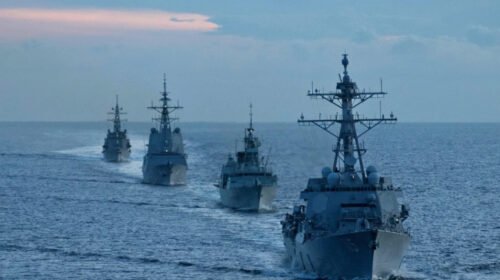
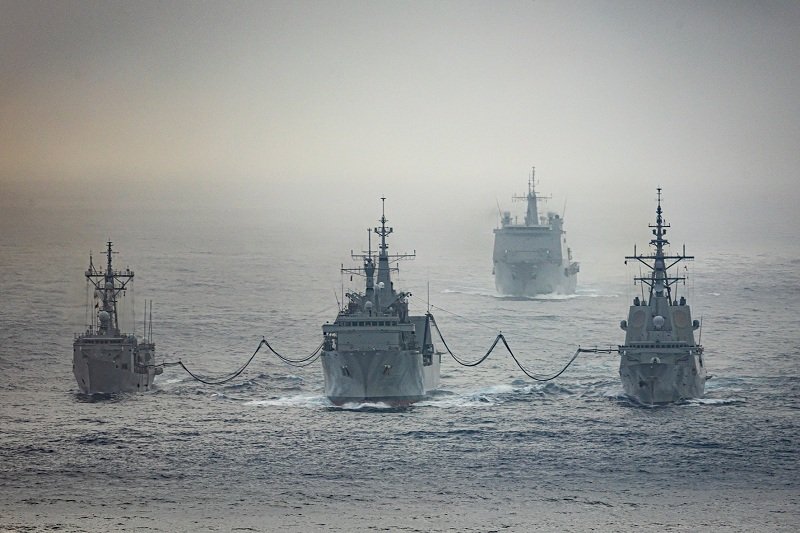
The Expeditionary Battle Group ‘Dédalo 25-3’ concludes its deployment in the Atlantic Ocean and returns home.
This completes the third and final phase of this year’s deployment, which underlines “the nation’s capability to deploy a naval force far from our borders”.
On October 8, the warships of the Expeditionary Battle Group (EBG) ‘Dédalo 25-3’ departed from Norfolk Naval Base on the east coast of the United States, bound for Spain. After seventeen days crossing the Atlantic Ocean, the naval group arrived in Spain today, thus concluding the third and final ‘Dédalo’ deployment scheduled for this year. During the final days, the EBG naval units separated to enter different port: the Amphibious Assault Ship ‘Galicia’ (L-51) and the frigate ‘Canarias’ (F-86) docked at Rota Naval Base, while the frigate ‘Almirante Juan de Borbón’ (F-102) docked at the Ferrol Arsenal.
There remains a naval deployment —more than two months of intense and hard service at sea and from sea— working side by side with units from more than 25 countries during the UNITAS 2025 exercise, organized by the U.S. Navy and the United States Marine Corps. During this time, the Spanish naval group —the ships and their crews— has crossed the Atlantic twice and has demonstrated its operational readiness in this extraordinary international training exercise. This deployment has also increased the readiness of the units, and reinforced the presence and prestige of the Spanish Armed Forces on the national and international scene, in addition to promoting interoperability with friendly and allied countries.
At the helm of this naval group was Rear Admiral Antonio González-Tánago de la Lastra, who only has words of gratitude for all the military personnel who made this mission possible. “An operational activity, he notes, that demonstrates the national capability to deploy a Naval Force far from our borders for an extended period of time.” Furthermore, this mission has generated impact thanks to its projection capabilities, with its aircraft and the Marine Corps’ landing force. “It must be emphasized, Admiral González-Tánago says, that the Expeditionary Battle Group allows us to carry out surveillance, cooperation, support for national industry, disaster relief, deterrence, defense, and attack activities anywhere in the world. And all this thanks to the extraordinary performance of our units, which is based on the professional competence, spirit of sacrifice, and camaraderie of all the servicemen who serve Spain at sea and from the sea. I am very proud of all the men and women who have made this feat possible.”
During this time, the men and women of the ‘Dédalo 25-3’ have shared days of sailing in joint and combined exercises; they have assisted Spanish-flagged civilian vessels; they have carried out landings on beaches in various countries, and as always, they have demonstrated the training, expertise, and dedication that characterize the Spanish Navy. But beyond the effort and the fulfillment of operational objectives, the best moments spent with their comrades, the pride of service to Spain, and the satisfaction of the mission fulfilled, remain in everyone’s memory.
Now, after months away from home, families have welcomed their sailors and marines with open arms. All of them, as members of the Expeditionary Battle Group ‘Dédalo 25-3’, are returning home to recharge before setting sail again next year to begin the first ‘Dédalo 2026’ deployment. A new deployment that will maintain and strengthen the national commitment to international security, peace, and the well-being of Spain and its citizens.