
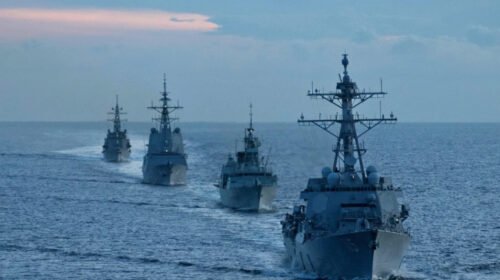
The Frigate “Defensora” departed from Abidjan in Ivory Coast June 25 in the last African port of the commission, and heads towards Brazil, with an estimated arrival on July 5, at the port of Cabedelo, Paraíba. Operation “Guinex V” will be concluded on July 12, in Rio de Janeiro. An initiative of the Brazilian Navy (MB), carried out annually since 2021, the Operation has already included the ports of Cape Verde, Senegal, Ghana, Nigeria, Cameroon and São Tomé and Príncipe, promoting training with friendly navies and coast guards in the region.
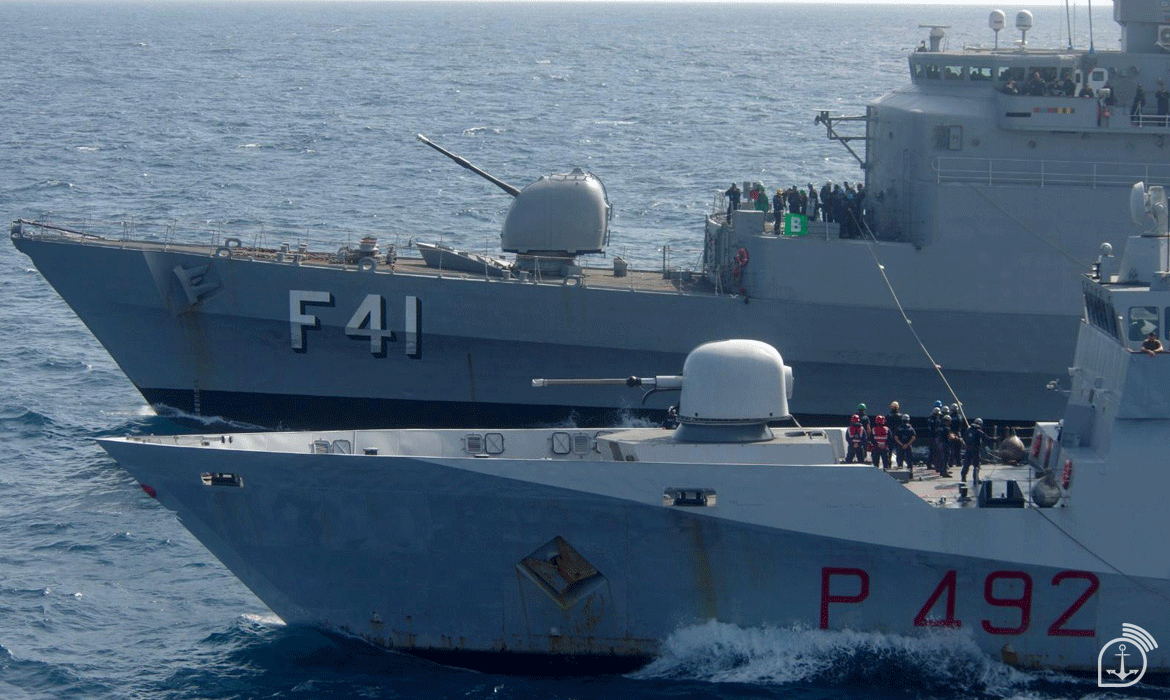
During the route to Abidjan, the Frigate “Defensora” carried out the Light Line exercise with the patrol vessel “Comandante Bettica”, of the Italian Navy. The procedure consists of the lateral approach and passage of a cable between the vessels, by means of manual throwing or with the aid of devices. The maneuver can be used for refueling at sea, transfer of cargo or personnel, with the necessary adaptations.
Operation “Guinex” aims to promote Brazilian naval presence in the Gulf of Guinea, on the west coast of Africa. The participation of the Frigate “Defensora”, with a contingent of approximately 260 military personnel, reaffirms Brazil’s commitment to stability in its strategic environment, contributing to the development of local capabilities, the surveillance of jurisdictional waters and the protection of maritime resources in one of the most important regions for international trade.
During a reception event on board the Brazilian ship, the Deputy Chief of Staff of the Ivorian Navy, Rear Admiral Amara Kone, stated that Brazil has sought, through its actions, to create and strengthen maritime cooperation with the countries of the Gulf of Guinea.
“We will take this cooperation forward, advancing in education, training, operations and, above all, in the exchange of information. On behalf of the Ivorian Navy authorities, I affirm that we are ready, we are together and we are with you,” he highlighted.
According to the Commander of the “Guinex” Operation Task Group, Rear Admiral Antonio Braz, in addition to combined training and exercises, naval diplomacy is one of the important aspects of the commission.
“Through naval diplomacy, we project not only our maritime power, but, above all, our commitment to peace, dialogue and joint development. Operation ‘Guinex’ reinforces the importance of historical and cultural relations between Brazil and the African continent, in addition to opening space for the exchange of experiences and the construction of truly cooperative maritime security,” he highlighted.
According to the Brazilian ambassador to São Tomé and Príncipe, Pedro Luiz Dalcero, Operation “Guinex V” is a concrete demonstration of Brazil’s commitment to the South Atlantic Peace and Cooperation Zone (ZOPACAS) treaty, which will celebrate its 40th anniversary in 2026. Created in 1986 at the United Nations (UN) on a Brazilian initiative, ZOPACAS seeks to promote regional cooperation and the maintenance of peace and security among participating countries.
“The journey undertaken by the Frigate ‘Defensora’, with our equipment and human resources deployed thousands of nautical miles from the Brazilian coast, demonstrates Brazil’s commitment to its African partners. This becomes even more relevant in a global context marked by economic, social and climate challenges and the increase in armed conflicts,” he highlighted.
More than seven tons of donations are delivered in São Tomé and Príncipe
During her visit to São Tomé and Príncipe on the 14th, the Frigate “Defensora” delivered more than seven tons of donations to local religious entities. The donations, consisting of basic food baskets, toys, clothes, hygiene products, school supplies, bandages and other materials, were collected by Brazilian religious institutions and loaded onto the frigate. The delivery ceremony was held on board the ship, with the presence of the Brazilian ambassador to the country, military authorities and representatives of the benefiting institutions.
Yata Lima, a Brazilian missionary from Youth for Christ in São Tomé, highlighted that the school supplies will benefit around 800 children, while the health supplies will guarantee one year of care in the project to treat wounds for the population. “We are deeply impacted by the arrival of these donations, especially the school and health supplies. Even with the frigate returning to Brazil, in a way, it will remain with us for a year, in our daily lives,” he stated.
Sequence of operational exercises
During the mission to the Gulf of Guinea, the Brazilian commission held workshops, operational exercises and naval diplomacy activities in all seven countries visited. The activities reinforce Brazil’s commitment to regional maritime security and strengthen strategic partnerships on the African Atlantic coast.
Between June 21 and 25, during a stopover at the port of Abidjan, the Navy held several workshops with the participation of Ivorian military personnel. The activities included first aid, damage control, seamanship and visit, boarding, search and seizure (VBSS) techniques, used by ship crews to inspect vessels suspected of illegal activities, such as smuggling or piracy. After undocking, already on the high seas, the Frigate “Defensora” conducted practical boarding exercises with the Ivorian Navy.
Among the ports visited, Lagos, Nigeria, was the highlight of the boarding exercise (VBSS) carried out with the vessels “Shere” and “Faro”, of the Nigerian Navy. The frigate “Defensora” simulated being a merchant ship with victims of a pirate attack. The Nigerian boarding detachment responded to the distress call and conducted the boarding on board, following all the procedures used in real situations. Then, the Brazilian military personnel participated in another exercise on board the vessel “Faro”, which, in the simulation, was suspected of illegal fishing.
In the port of Kribi, Cameroon, in addition to the boarding exercise (VBSS) with the CNS “Dipikar”, a patrol vessel of the Cameroonian Navy, the “Leap Frog” exercise was also carried out, consisting of approach maneuvers between the vessels. In the first phase of the boarding exercise, the Frigate “Defensora” acted as a vessel suspected of illegal immigration, receiving the Cameroonian team, which inspected the internal compartments until locating the simulated immigrants and then moved to the bridge, the ship’s command area.